
From Kit to Coastal Cruiser, Building an Electric AROHA
with John Pratt
This presentation is now available for replay
Description:
Professional boatbuilder Eric Blake will interview amateur boatbuilder John Pratt about his single-handed build of a beautiful AROHA Coastal Cruiser. John has an inspiring background and so many good insights about a project of this magnitude as an amateur. And she’s the first ELECTRIC AROHA! So we’re as interested as everyone else to see (and not hear) the results. Live Q&A at the end.
Speakers:
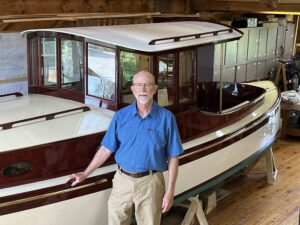 John Pratt – Amateur boatbuilder
I was born in Pennsylvania, grew up in South Carolina, finished high school in Ohio, attended law school in Massachusetts and practiced patent law in Atlanta, Georgia before retiring to southwestern North Carolina. I started woodworking as a child but, except for two summers during law school, I did not get to do woodworking full time until I retired from the law about nine years ago. I have built about six boats, including the William Garden cat boat Tom Cat, a Haven 12 1/2 and a skin-on-frame Adirondack guide boat. I also build furniture and classical and archtop guitars.
Links:
- Learn more about the AROHA plans & kit available.
You and both J.R.Brealls are American treasures, tThank you for sharing this experience.
Beautiful! What are the speed and cruise range with the electric setup?
At hull speed, about 7 knots, Icruising range is about 6 hours/42 nautical miles. Above about 9 knots, current draw causes the batteries automatically to shut down, so I have not determined speed and range at higher speeds.
Thanks John and Eric, a very nice interview on building my favorite boat. I love the comment that moving heavy things single handed will yield to careful thought. Words to work by!
John your boat is a work of art finished at an incredibly high level.
Thanks, Bob!
Enjoyed learning about this beautiful boat and how it was built.
Your execution of that design is a Stradivarius, no ordinary fiddle. Bravo John.
Great build. Do you have a next boat in mind? Pete
No next boat in mind yet.
Wow. What an amazing guy.
Wonderful build of a beautiful boat, and a great presentation. Thanks!
perfect response! Chuckling, yes!
Mike &Mo in Oriental North Carolina ,
thanks John for sharing your beautiful project . We just finished Oohna and are considering AROHA
All the Best.
By any chance did you log (keep track of) — total hours from beginning to end?
Have any concerns about Lithium safety?
How much battery capacity? What is the approximate weight of the batteries?
About 48 pounds each, so 8 batteries x 48 pounds = 384 pounds.
I am currently building a 32 foot electric power boat. 96V two 12KW motors and 40 Kwh of battery capacity. 880 lbs of batteries.
Beautiful work!!
How far/how long can you be out on the lake before the batteries need a re-charge? How many coats of clear epoxy did you apply? Do people ever apply varnish on top of epoxy coats or no?
Christine from Canada! 🙂
Could John expand on the choice of an electric drive system and all of the assembly, bedding, alignment, wiring choices, voltage selection and final method of test prior to launch. Problems encountered would be nice also.
Does John also plan to add any solar modules and solar controllers for his wonderful creation.
I choose electric for environmental reasons and for quiet running. Mechanical installation was, so far as I know, much the same as it would have been with a diesel motor. (I had never before installed an inboard boat motor.) The Electric Yacht motors are designed to replace diesel motors on sail boats, so they fit conventional boat motor spaces. The motor I used is 48 volts, which is a good compromise between the demand for power and limiting the length of the battery strings (to four in series). 48 volts is also a fairly safe voltage. Wire sizes were the code required sizes for the amps to be “drawn” through them, mostly 4/0 and 2/0 wire. The final test before launch was to turn the system on and advance the “throttle” until the propeller shaft began to turn (happily, in the desired direction). All further testing was in the water. Problems were relative few. I tend to “over engineer” things, which in this case related to the small engine box I built. That made it challenging to get the profusion of heavy cables to fit the relatively small space the motor box provided.
Any update on the first AROHA that slipped its mooring ball suffered damage? I know it was for sale at some point. Hope it’s getting the care it needs and can get back in the water.
NYMPH was at the Mystic show last summer.
I see that the introduction mentions that you built the AROHA single-handed. Surely there were times when you needed help, for example when steam bending of heavy lifting?
What tasks during the build particularly needed extra pairs of hands?
My wife helped me bend the coach house coaming when I was installing it, and she mixed epoxy as I spread it on the pilot house roof layers. She probably likewise provided a second set of hands 2 or 3 other times. More important, my wife provided generous quantities of moral support throughout the project. I also had 2-3 friends helping me get everything in position when I backed the trailer up under the boat suspended from ratchet straps and decided where to position the trailer fore and aft to begin fitting the trailer to the boat.
My wife helped me bend the coach house coaming when I was installing it, and she mixed epoxy as I spread it on the pilot house roof layers. She probably likewise provided a second set of hands 2 or 3 other times. More important, my wife provided generous quantities of moral support throughout the project. I also had 2-3 friends helping me get everything in position when I backed the trailer up under the boat suspended from ratchet straps and decided where to position the trailer fore and aft to begin fitting the trailer to the boat.
Do you have modified plans for the electric version?
No modified plans. The electric motor is positioned as is the diesel motor shown on the plans, and the drive shaft is unchanged. I measured for the drive shaft length with the electric motor in place.
What was the cost of the electric power package? If you don’t mind.
Cost was about $20,000 — half for the motor and half for the batteries, wiring, connectors, etc.