
Owner’s Description
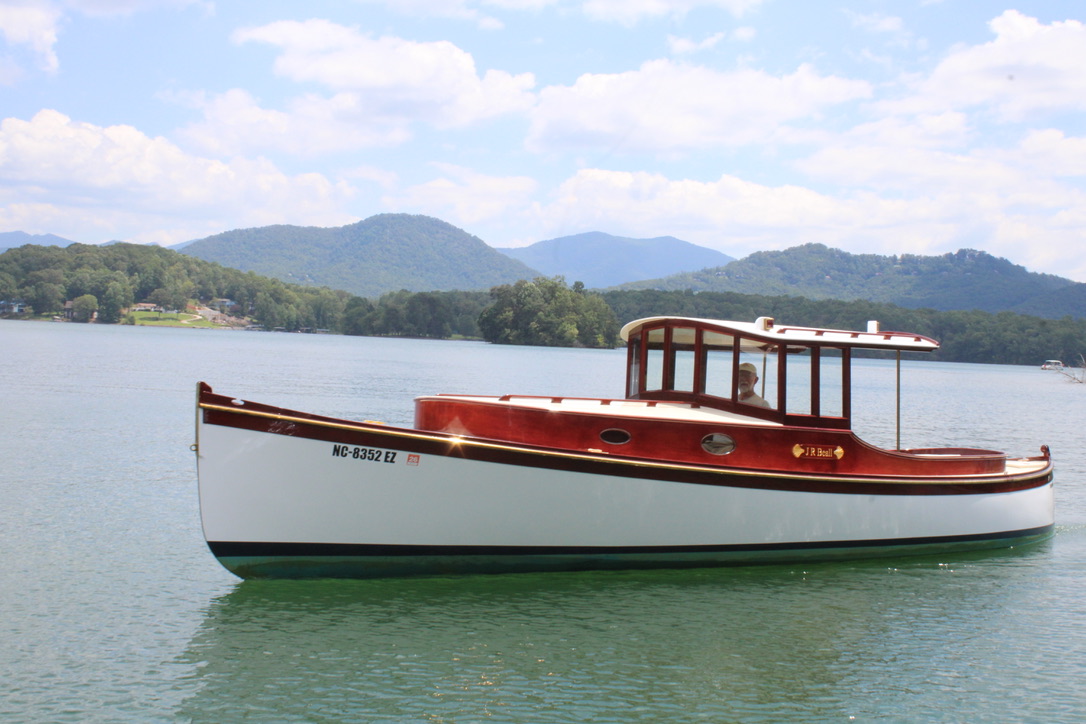
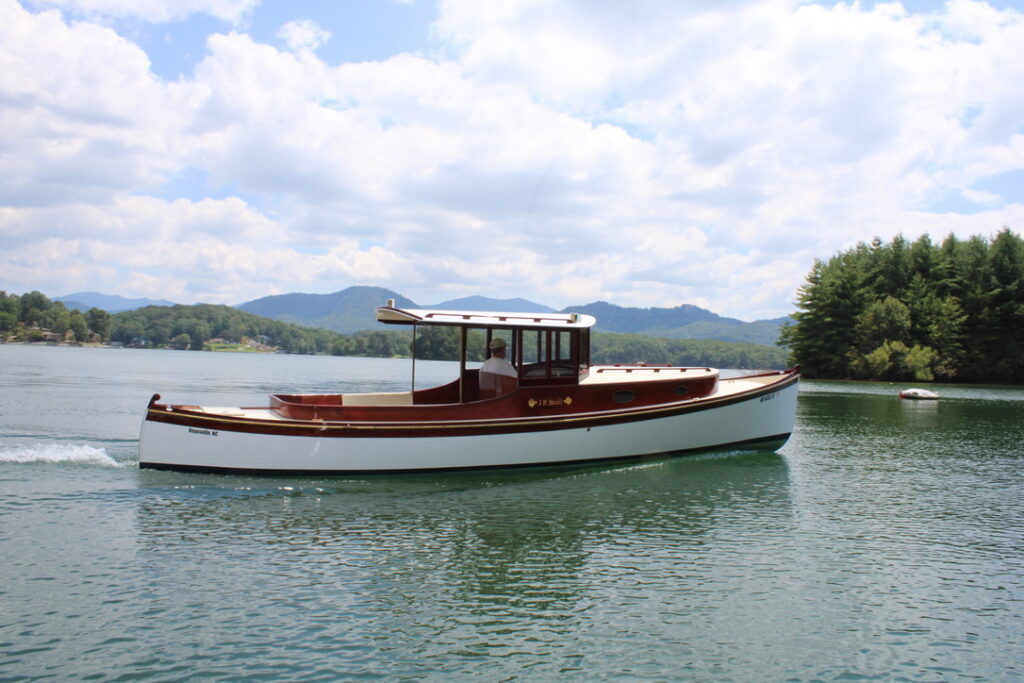
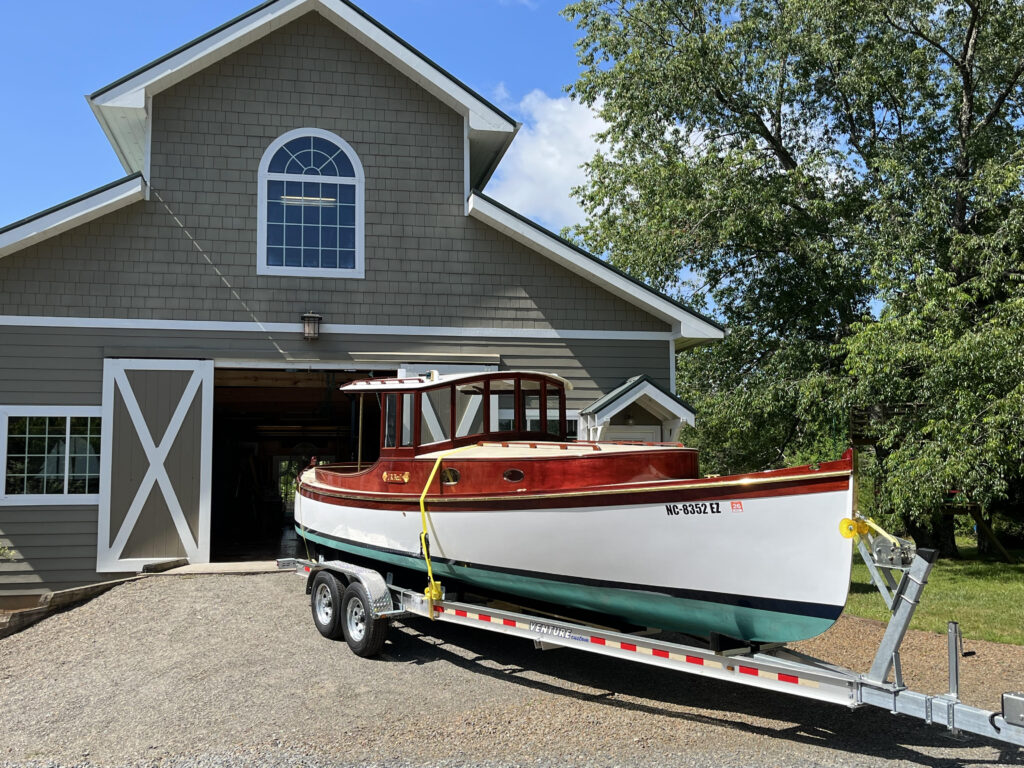
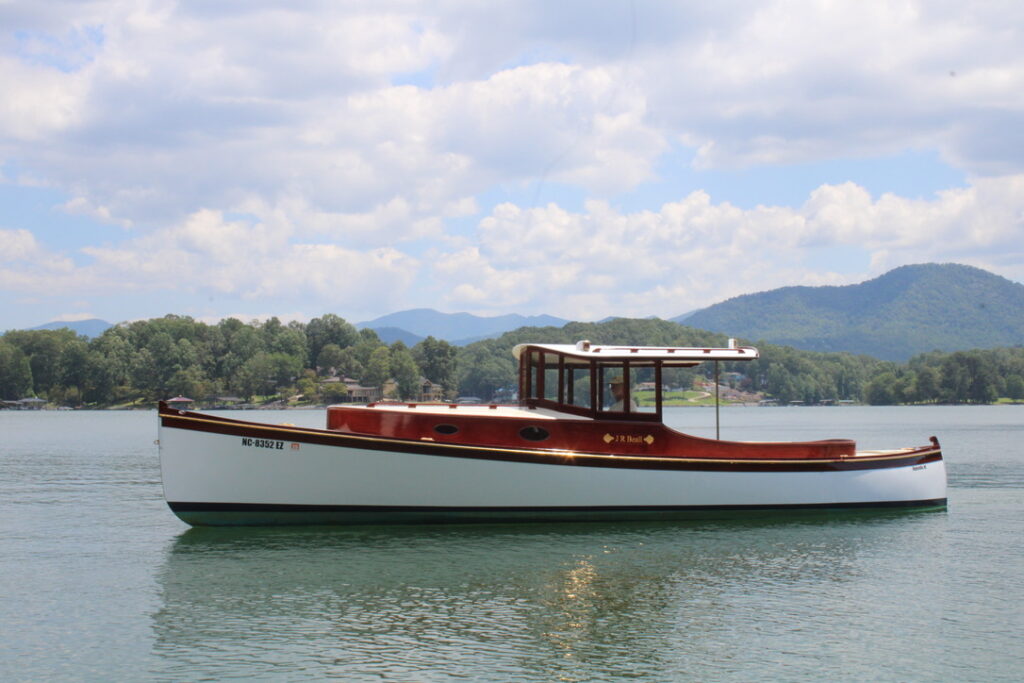
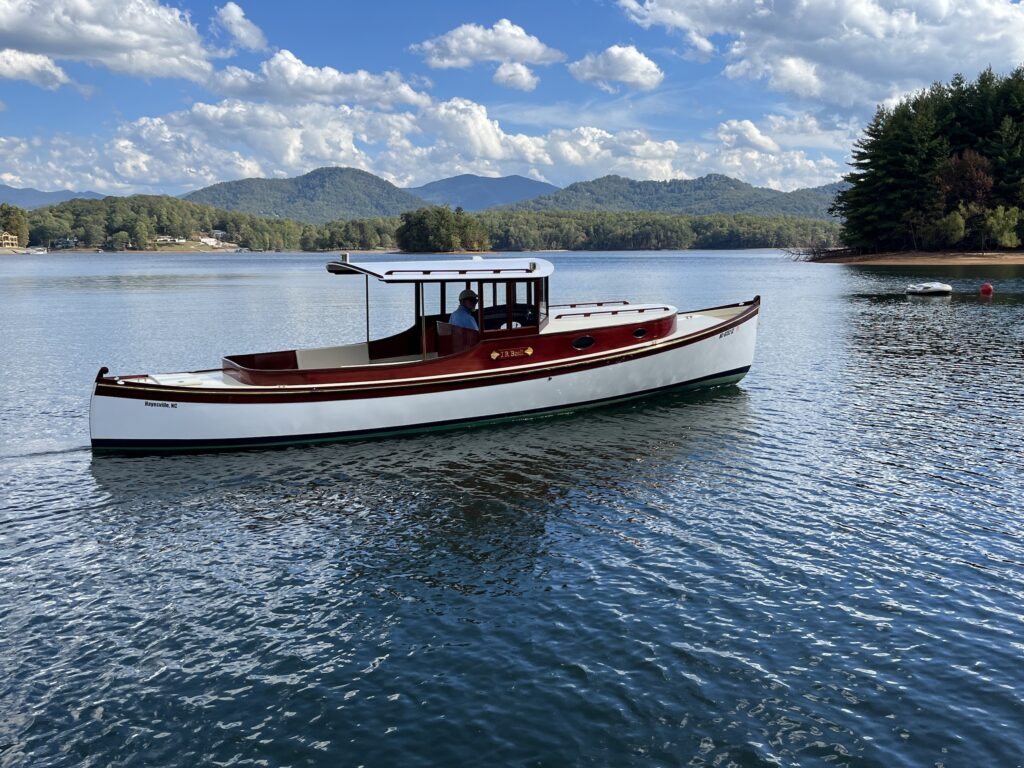
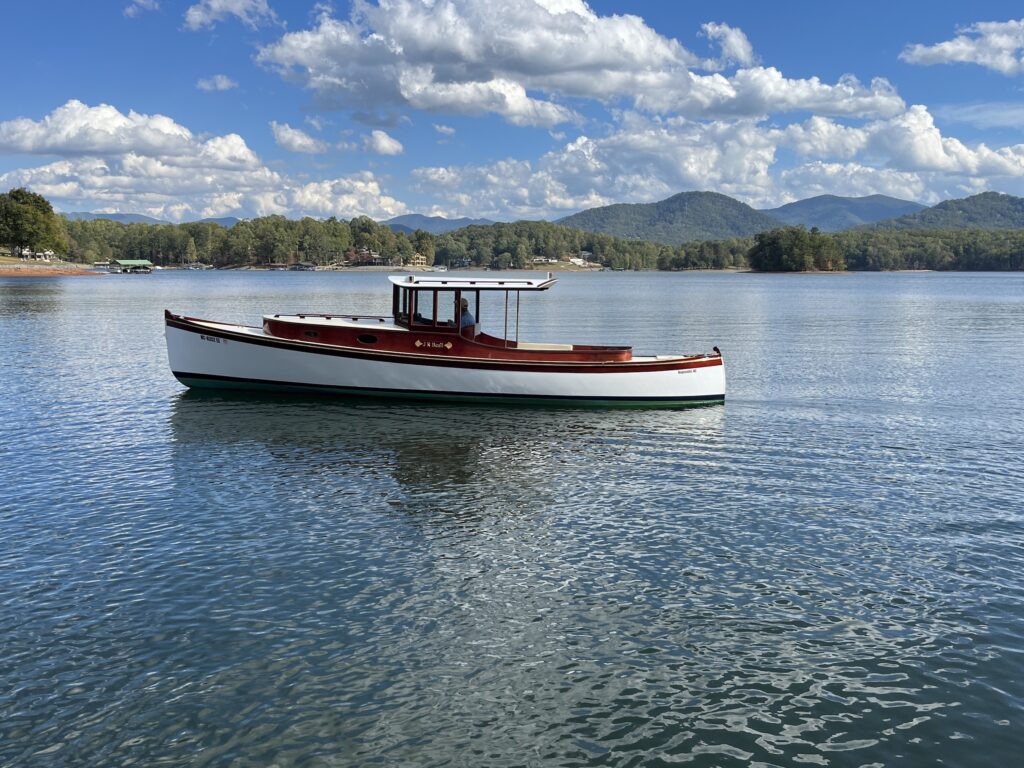
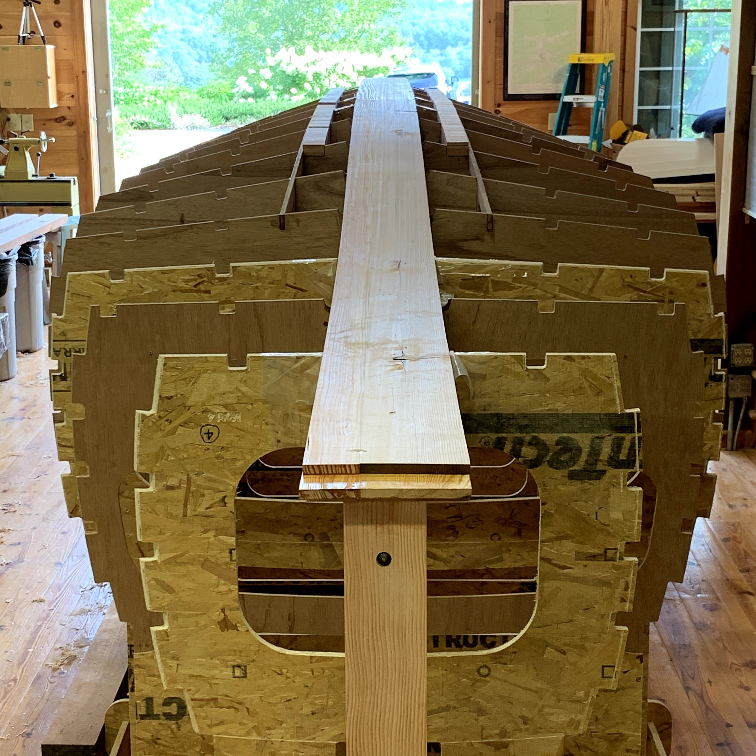
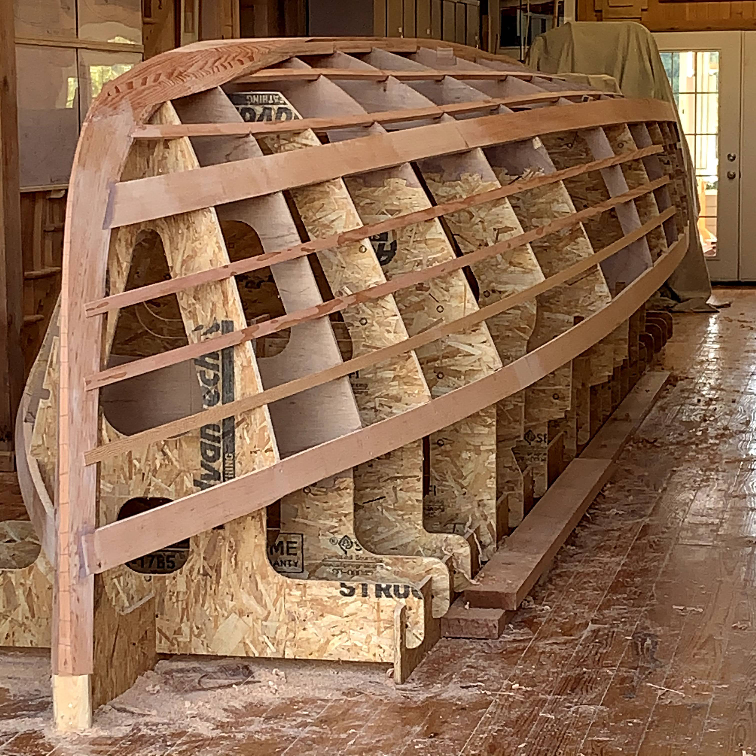
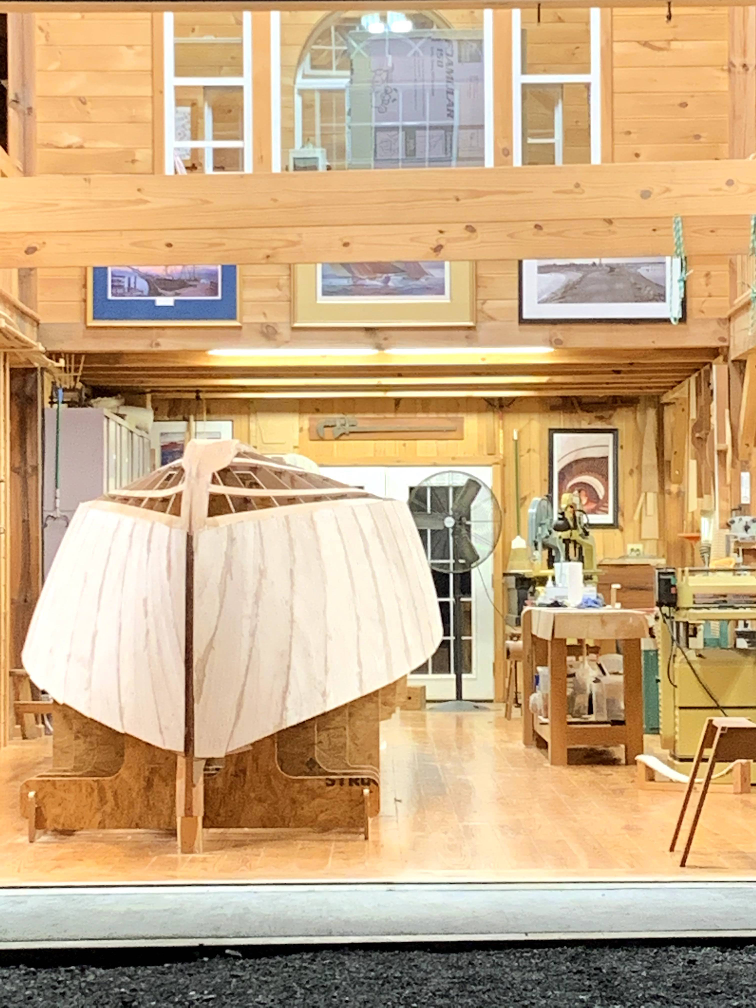
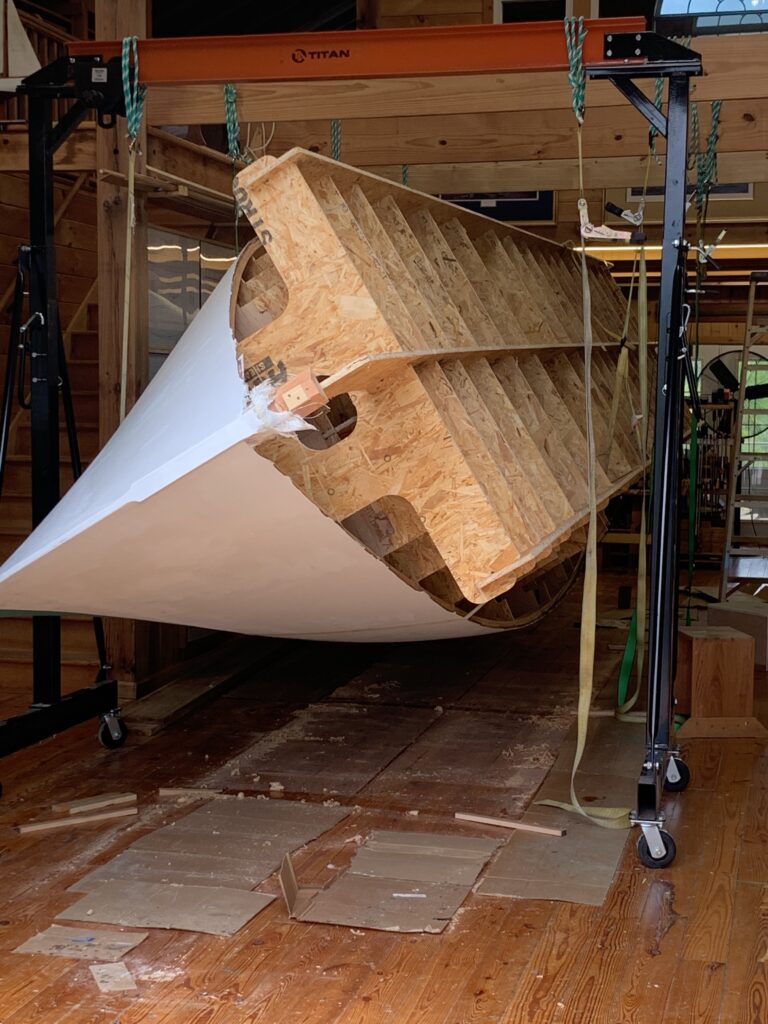
AROHA camp cruiser with electric propulsion. This was the first such boat begun utilizing Off Center Harbor plans and the frames kit. Construction began in August 2020 and was completed in June 2023. Materials were Douglas fir, Honduras mahagony and Meranti plywood.
I was smitten with Peter Sewell’s Whio when it appeared on the cover of WoodenBoat magazine in 2006, and fell I fully in love when OCH published the video of Maynard Bray’s visit to see her in person. That made me a pushover when OCH announced publication of the plans and release of the frames kit in summer 2020. Building AROHA seemed like a good way to spend the pandemic, and it was.
I began to focus on electric propulsion only after starting the project. Adding another fossil fuel vehicle was unappealing, and this easy-to-push-through-the-water hull seemed to cry out for electric drive, I use it on Lake Chatuge, a TVA lake in western North Carolina where I live, for outings of only a few hours at a time.
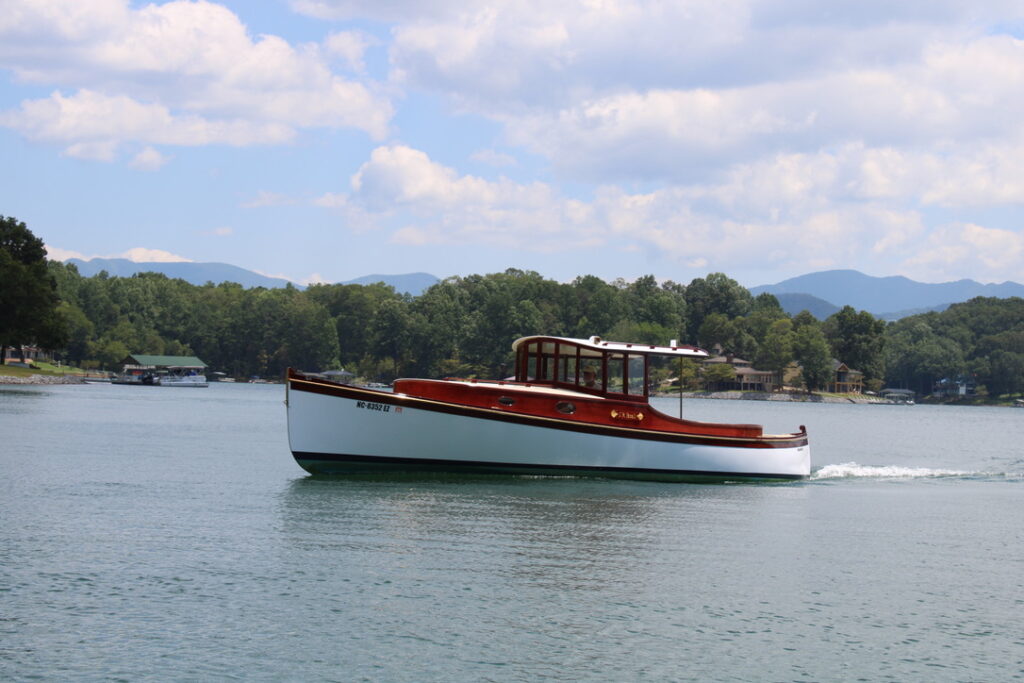
Range and time between charges depends on speed. It appears that a full charge will drive the boat at hull speed, about 7 knots, for about six hours. I cannot stand to be away from my workshop for much longer than that.
Probably the best result of choosing electric propulsion is the quiet. Normal volume conversations are possible and a pleasure.
The J R BEALL is named for my friend of more than 50 years, Jerry Beall, who celebrated his 90th birthday shortly after his namesake boat was launched.
J. R. is an extraordinary woodworker, and his influence on my woodworking was instrumental.
Across the arc of his career, Jerry has build musical instruments, clocks and wooden clock movements. He built both simple and amazingly complex kaleidoscopes, boats and furniture. His use of threaded wooden parts in his line of wooden clocks led him to invent improved devices for making threaded wooden components and to found Beall Tool Company, which is now owned by Lee Valley Tools.
The first boat I ever helped to build was in J. R.’s shop because J. R. wanted us to build it together, and I cannot imagine having tackled this project without J. R.’s influence.
Building the J R BEALL began, as boats often begin, with irresistible urgency, kindled by a picture or a sketch or an idea, a seed that sprouts and grows with every thought of the boat into a sparkling dream.
It is a dream pulsing with sound, the “snick, snick, snick,” of a hand plane making a wood surface smooth and flat while a gentle breeze through open doors scatters wood shavings as they curl from the plane to the boat shop floor. It is a dream scented with the perfume of cut spruce and Douglas fir. A dream of wood exquisitely shaped and fit perfectly together. Of wood faired and finished with flawless varnish on a deep red mahogany shear strake and pilot house, and luxurious white paint, smooth as cream, on the hull. A dream of polished bronze hardware integrally mounted as if it were married to the curved wood by the hands of angels. Surfaces are true and fair, finishes are flawless and smooth. There is no celebration of imperfections, no wabi-sabi here. It is a dream of perfection.
Flawless and complete, the dream ends with movement, movement afloat with a plumb bow gently rising and falling as it slices the water and curls bow waves up and away port and starboard.
Pursuit of the dream begins with hours studying the drawings, the foundation on which the dream rests and from which it will grow. Great boat drawings are remarkably beautiful in their own right. On a few sheets of flat paper a welter of lines embody an enormous amount of data, a two dimension code for a three dimensional object.
Early on, the dreamer retires at night with visions of exquisite bits of boat dancing at the edge of sleep, rising from the flat drawings into weightless, flawless wood parts with width and breath and depth. The parts float together, effortlessly, perfectly joining themselves together.
Later, when the inevitable project issues arise, the dreamer goes to bed burdened with problems to solve, sometimes before sleep can come and sometimes later, in those portions of the brain that keep working as we sleep. Insomnia used to call up work anxieties that chased sleep, an unavoidable spiraling roll call of all the unwelcome baggage of life. Now night time wakefulness is quickly dispatched by calling up a few sweet, reassuring thoughts of the dream.
We think of “dreamers” as happy people not entirely in touch with the world’s stern concept of reality. Boat struck dreamers carry their vision into every corner of their lives, a sometimes secret intoxication and buffer. In the face of unhappy reality the dreamer is comforted to think, “yeah, but I have a dream.”
Dreams notwithstanding, boatbuilding is hard, the builder’s reach constantly exceeding his grasp. Even the best drawings don’t show everything there is to a boat, and the drawings provide little help at all in figuring out how to make boat parts shaped like the curving lines in the drawings. Indeed, as M. C. Escher delightfully demonstrated, it is possible to draw structures that cannot be built in the three dimensional space we actually inhabit.
There are lots of tools and techniques for making wood flat or straight, but almost none of the wood surfaces in a boat are either of those things.
Between first rolling out boat drawings on the bench and the “finishings” are months and years and thousands of little, sometimes taxing and tedious tasks, both driving toward and driven by the dream. There are seasons of hull building, of cutting and shaping and gluing, of building the boat furniture and installing decks, of sanding and painting and sanding again, with a nagging skepticism that it will ever end. Fortunately, the memory of the tedium shrinks quickly, fading into a few largely timeless, emblematic recollections of accomplishments. It becomes clear that impatience is the chief enemy of perfection.
Practice and repetition are the sherpas of the climb for perfection. The experienced dreamer/builder knows that irony lurks just over every peak. Each completed project is a sign, sometimes almost a flashing neon sign, pointing toward even higher peaks of sophistication, finish, ornamentation and function. Ironically, the builder’s appreciation for what could be, for what perhaps can be, constantly leap-frogs every advance of skill.
After finishing, the completed, imperfect project is a bittersweet product. I contemplate it with pride and a little wonder that something so large and fair could have come to be by my hands. But as the author of its imperfections as well as its merits, it often seems I can see only those flaws, forcing me each time I look at what I built to reconcile myself again to failure to match the dream of perfection.
But that is not the end of the story; there is a privilege of age in contemplation of not just boats.
Sometimes, with the passage of time, memory of the imperfections fades and my vision blurs. If the air is warm and the backlighting from the sun is just right, what I see before me merges with my recollection of the dream. Then I think, “perhaps I grasped perfection after all.”
Photos
Video
A Tribute from John Pratt to His Mentor J.R. Beall
Map
No Records Found
Sorry, no records were found. Please adjust your search criteria and try again.
Google Map Not Loaded
Sorry, unable to load Google Maps API.
Comments
Post a Comment Cancel reply
You must be logged in to post a comment.
7 thoughts on “29' Sewell/Sturdy Electric Coastal Cruising Launch (2023) - J R BEALL”
Owner’s Description
Photos
Video
Map
Comments
Post a Comment
You must be logged in to post a comment.
7 thoughts on “29' Sewell/Sturdy Electric Coastal Cruising Launch (2023) - J R BEALL”
Lovely boat! All things are possible with passion and desire!
John, your tribute to friendship is well and truly represented by your creative work on both boat and script. J. R. Must beam with pride and affection at every sight of his Namesake! I certainly would. What a beautiful rendering of a beautiful design. May she/he always give you peace, pleasure, and satisfaction. Say hello to J.R. From this California boy. Friends who know Jesus are friends forever.
What a dream boat and electric too : it’s a joy to witness this great result as for the entire boats listed on this show there is a sort of tragedy for us willing to enlarge the pictures and not being able to : one love from France to all boat dreamers 🫶🏼
Quite a shop! Your lake looks beautiful too. Our daughter lives outside Asheville and now I’m tempted to rent a boat on your lake when we visit.
Thanks! We are fortunate to live and work in beautiful places.
I think you captured the essence of it all, and very eloquently! Not to mention a fabulous result for your labours. The Aroha is a wonderful creation!
Cheers from Australia!
Thanks for your kind words, Dave. Spelled as you do, “labours” somehow seem more worthwhile!