Open Boat Camp Cruising
with Geoff Kerr, hosted by Steve Stone
This presentation is now available as a replay
Leave your questions and comments below!
Steve and Geoff will continue answering questions there.
Description:
Geoff Kerr teaches an Open Boat Camp Cruising course at the WoodenBoat School, and he’s among the most experienced camp-cruisers in this part of the world. Geoff will walk us through the most important topics, answering the top questions of those who are keen to explore far-off places in small boats. Off Center Harbor co-founder Steve Stone has camp-cruised the entire coast of Maine and will host Geoff and lead the Q&A that follows Geoff’s presentation.
Live Q&A to follow.
Speakers:
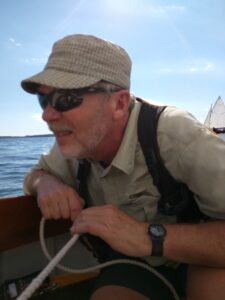 Geoff Kerr – Teacher, Camp Cruiser
Although I grew up in a boatless North Carolina family, I was graciously innoculated by a family friend with a motor cruiser and an infinite stack of back issues of all the magazines. As a 16 year old casting about for a summer adventure I responded to a magazine ad for the Hurricane Island Outward Bound School. That cold and foggy June in Penobscot Bay introduced me to a lifetime love of sailing and open boat adventuring. College back in North Carolina gave me lots of opportunity for marine science studies and for sailing other people’s boats. An ad in the campus newspaper lead me to a commission as a U.S. Coast Guard officer and 3 years at sea aboard a 180‘ research vessel with pre-GPS cruises ranging from the Grand Banks to Columbia. Our homeport was just down the road from Mystic Seaport which afforded me weekend musing time and an introductory course in wooden boat building. Those years and the next decade or so were once again spent in other people’s boats. Time, money and growing children finally aligned in the early ‘90’s, and armed with Celtic/Norman DNA, a stack of WoodenBoat magazines and a wealth of optimism I built my first boat, a Caledonia Yawl. That experience lead to a now 30 year career as a boatbuilder (5 years with Joe Youcha and the Alexandria Seaport Foundation, and 25 years on my own as Two Daughters Boatworks). I’ve also spent those 30 years sailing and adventuring in “Ned Ludd”, my original Caledonia, wearing out two trailers, 4 tow vehicles and two suits of sails. Over those years I’ve built over 30 of Iain Oughtred’s designs and some 40 other adventure cruising boats ranging from Chesapeake Light Craft prototypes, Francois Vivier pocket cruisers, Graham Byrnes speedsters, a one-off Gartside motor cruiser and a pair of Doug Hylan outboard garveys. To get me out of my cave in the hills I’ve been very fortunate enjoy teaching at The Wooden Boat School for the last 20+ years. That summer gig has afforded me an annual opportunity to cruise and camp the coast of Maine, and to develop the curriculum for the Open Boat Cruising course we’ve been offering at WBS for the last five or so seasons. That summer time in Brooklin also introduced me to the OCH crew and lead to our past collaborations. These 50 years of sailing, thirty years sporting about in Ned Ludd, and the twenty teaching boatbuilding, sailing and adventuring in Maine have contributed to the thoughts and principles I’ll offer in our Worldwide Classic Boat Show presentation.
Leave your questions and comments below!
Geoff
Thank you for your how to build series. I alternately laugh and cry at how neat and tidy your work is and how well things seem to fit.
My Caledonia is at the floor board stage and I’ll be sailing this spring.
I’ve not seen an access port for a pump alongside the centerboard trunk and where might the best location be for the last drops?
I’ve found the Caledonia will happily heel for you to pump from a comfortable and safe position, Try sitting at the corner at the junction of the aft thwart and side bench, The fwd thwart with the pump at the mast step works nicely too.
Had a feeling that would be the answer, and nowhere to lose the corkscrew.
Thanks
The presentation was probably useful in general terms for the inexperienced who are unaware of the possibility of using a simple open boat for more than a day sail in sheltered waters. However for competent sailors looking to extend their horizons there was little practical detail to add to their knowledge and further presentations of a more technical nature would be useful and most welcome. From my own perspective as an experienced multihull builder and cruiser here in UK and European waters who is looking to downsize without losing the advantages of speed, none-heeling comfort,unsinkability and self draining cockpits that multihulls can offer, I would welcome some reference in future presentations to this genre of small seaworthy boats.
Thank you Geoff and Steve. Wonderful presentation. You covered so many topics and it just flowed so well. Loved the inclusion of “Sailing is Grace, not drama and if someone is yelling at you, get off the boat and find yourself another skipper! The best sailors are often the quietest.”
Thank you for the fun talk. You reminded me that as a young man I got the vision of sailing all the Chesapeake tributaries from their headwaters😂 I started with the Chester river and had my brother drop me and my Danny Greene Chameleon nesting dinghy at the headwaters one June. Three days later I made it to the river mouth, worn out… I found the camping concern to be grazing cows on the river bank.
Excellent, informative presentation.
Nice photos and video accompaniment.
Thanks, Geoff and Steve!
I watched most of this live yesterday. Thanks for the inspirational and instructive presentation. Geoff’s thoughts on safety, planning, being an ‘active captain’, and exercises for incrementally getting into the sport are good advice for any boater.
Thanks for a great and inviting presentation on camp cruising. One question I didn’t see asked was how you handle the occasional but necessary task of going to the bathroom both on board an open boat as well as camping on a deserted island, especially if you are not sailing alone?
I got a bit short on time Friday night and omitted this important issue. I highly recommend having a stout, soft sided bucket aboard, as a dewatering device for both the boat and the crew. Countless persons overboard are recovered with their trousers down or flies open. Heave to and keep yourself safely inboard. Wag Bags as mentioned below are a fabulous commercial product used in all the outdoor disciplines., and suitable for both afloat and ashore. I like a similar, homemade system involving ziplocs, newspaper and baby wipes. These can be made up ahead of a cruise and several distributed to each member of the party. I got the idea from the Maine Island Trail Guidebook. After use they just get stashed in the trash bag, and are far easier to live with than a thunder box.
Thanks Geoff, Steve and Nate for taking the time to answer my question. You truly care about taking the time to help folks learn more about boating and it shows.
I use Wag-Bags both in the boat and on the islands. They work well.
Geoff and Steve will surely have more to add, but I can’t recommend the “Modesty Poncho” enough (originally called the “poopooponcho”)!
My brother and I came up with it in our R2AK preparations.
It doesn’t address what you DO with your waste, but it does create a personal outhouse anywhere you want. Just put on the poncho, sit on the bucket, keep a few secrets from your crew/onlookers.
Thank you Geoff and Steve for sharing your wisdom. Camping on the islands off the Maine coast is special indeed. Happy hour while watching the sun set is just incredible. Hope to see you on the water one day.
Thanks Geoff and Steve! Geoff, ever since taking your open boat cruising course and subsequently building my own Caledonia Yawl, I am inspired to be a better sailor every time we cross paths. Tonight was no exception. How could anyone not get more excited about pushing away from the shore and catching the wind. Fair winds! Thank you!
Fabulous Camp/Cruising presentation by Geoff and Steve. I am about to enter season five with my Caledonia Yawl and I have never slept on her . . . that has to change.
Thanks Donald. My tent is the Decathalon 2 Seconds 2, and it’s a perfect fit for the Caledonia Yawl. First night sleeping aboard, Amy woke up in the middle of the night and said: “OH MY GOD!” . . . (and I started thinking about how I would get her ashore deep up into Somes Sound in Acadia National Park . . . and she finished . . . “I haven’t slept this well in YEARS!”
Thank you Geoff for all the great info about camp cruising.
Thanks guys, . Enjoyed it greatly.
Dad you are our hero!
Rule for being a good captain:
Make you and your passengers feel like the audience, NOT feel like the show!
Amazing… being a sea sick sailor… I really hope to overcome my hesitancy from worry of being so uncomfortable…says the person who has lived aboard for 30 years!
Geoff–thank you so much for such a wonderful talk. I have read the many camping articles in WoodenBoat. Just want to express my gratitude. FYI–I live in DC and have spent time off and on at Alexandria Seaport Foundation. Thank you
and he laughs at our jokes!
G’day from Western Australia
It’s 9:30 Saturday morning here…
Thanks for that inspirational talk.
Just wondering is towing a lure or carrying and setting lobster or crab pots for a bit of self sufficient sustenance a popular addition to your camp cruising kit?
Cheers
I have fished a bit now and then, striped bass in season. In Maine I usually carry lemons, butter, a pot and a stack of $5 bills, then flag down an late afternoon lobster boat.
Have youall tried our Florida Lobster (Cray fish, no big claws)?? Even better is Stone Crab!! Scarce now, but as a kid use to take one claw and end up with a quart jar full of meat. Now I think Gold /oz. and Stone Crab meat are about the same price.
Seems like handheld electronic navigation would be a good idea? I carry charts, but also have Navionics on my phone and a waterproof tablet. It saved by wife and I when the fog rolled in and we couldn’t see more than 25 yards.
Also seems like scheduling in an extra day or two, just in case the weather is really bad and you can’t sail.
Thanks,
Bill
I use navionics on my phone and wouldn’t leave the dock on a cruise without it now. I don’t use it a lot. We mostly a chartbook to stay present in the natural zone, but navionics tells me exactly where I am at any moment, and it can give me a much better idea of a new area that I’m going to approach for the first time later in the day, so there are times when this convenience (or safety factor) is worth the electronic screen viewing. There are a lot of reasons to not get yourself in a position to need to rely on it, and I never have (yet), but when used moderately the safety and pleasure can far outweigh the unpleasantness of looking at a screen for a few minutes (for me).
I personally find small screen electronics very frustrating. So easy to get focused on the screen and not what’s ahead, let alone steer by compass ad trim sails. With a navigator aboard it would be different though, so each to our own. Open ended schedules are so comforting!
.
I agree about the phone. Too small! I use have a water and shockproof tablet to run Navionics. Reasonable size screen and very accurate GPS. If you stare at it all the time you will drain the battery. Trains you to use it only when needed!
Geoff, thank you for the session, I’m finalizing my preps for going for a 5 day cruise down in the gulf off of Florida in my PocketShip. As someone currently working on boat crew quals for the CG Aux (Portsmouth Harbor). You’ve reconfirmed my packing list with more safety gear than not including radar reflector, spare anchor and rode, etc. Big question which I feel was answered during the session, what is the right balance between too little and too much gear outside of handling and number of days? I’m concerned it will be like backpacking where I’m regretting too much gear as the days go on. – Drew – Hampton, NH
I’ll reiterate: Simplicity is the key to happiness afloat. If you take too much at least you won’t have to lug it on your back!
Perhaps you might mention internet blogs such as Steve Early’s The Log of the Spartina, or Roger Barnes’ YouTube videos, as a great source of inspiration, especially in the off season.
Are the masts on the CY able to support an average person in a hammock?
I’ve done it and would not recommend it from a safety perspective. It’s novel. Fun, yes. Unsafe if a wake hits you at the wrong angle. Here in Maine we have to sleep zipped into a sleeping bag, mosquito net, and rain cover. Not a good set of conditions to capsize in.
The boat’s initial stability is pretty tender…The masts might(!) take it, but the center of gravity will be unpleasantly rocky.
For those of us with large, ballasted boats, any thoughts on enjoying the beach and camping experience with the dingy while anchoring off in deep water?
Knock yourself out! Should be part of your routine. As you no doubt know, anchoring should be done even more carefully if you are going ashore.
What PFD do you recommend for rowing?
Some use Kokotat. That’s what I have. Good pocket for VHF radio and pockets for whistles, knife, etc. Paddling pfd’s are comfortable and I’ve heard the best pfd is the one you’ll wear. It’s not hot here in Maine so I wear mine almost all the time. The downside of paddling pfd’s is they don’t have the ability to right you and support your head out of the water if you go over unconscious. I figure our equipment is small enough that getting hit in the head and knocked overboard at that level would be possible but very rare, so that’s my calculation.
The rowing club I belonged to strongly recommended self-inflating PFDs (vests, not fanny packs) and I’m hooked. They are pretty much unnoticeable in use, but provide plenty of support and will keep your head out of the water if you get in real trouble. The major caveat is that they are huge when they go off, so you can’t do much if they discharge, and they have to be recharged. Not hard to do, but you need to pack back-up cartridges. I think they’re great when you only anticipate needing a PFD in an actual emergency. Definitely not for any activity that involves frequent dips in the water.
No specifics for you. I generally wear a sea kayaking pfd with free range of arm motion anyway. I do know that bulky chest panels can be awkward for rowing There are fanny pack style inflatables for rwers that I feel are simply to small and light for big water boating.
Has anyone put 3 rowing stations on a Caledona so that 3 camp cruisers can row. You admit that it is not fun for one person to row a boat that size.
That is an unknown for me. With three aboard I like to have two folks row sweep on the mid-thwart and have the third cox. You could add a station forward for a second rower, but someone should steer.
WRT the teenage rowers questions. The thwarts are a bit low for my tastes , even for my 6′ frame. I regularly sit on a 2″ foam seat cushion to tune the fit, and expect you could find the right booster for any rower. Finding the right oar length for the fwd station will take a bit of alchemy and experimentation. Formulae abound.
How can I be the kind of captain that people want to go out with (what are your leadership/social-skill secrets that have kept your daughters coming back summer after summer)?
How do you decide on the conditions required to go out into more open water? What did it take to make you comfortable going outside around MDI, for example?
I tried to characterize this in the discussion. You have to build up to it progressively by pushing your comfort a little bit now and then, planning your bail out strategy and being willing to back off. Try days with high winds in sheltered waters, or poking your nose out from behind an island into rougher water and then retreating. There is no need to make bad choices and terrify yourself or your crew.
Welcome, Nice to see you. I miss visiting you in your shop and gaining from your valuable experience.
Steve S
Hi Steve, nice to hear from you! Hope you are well.
Can you bring your cruising course to the west coast? My Caledonia is begging me to take her out more and that would be an awesome excuse.
Ron – If you live in the Northwest, the Pacific Northwest Pocket Yachters do a lot of camp-cruising—www.pocketyachters.com—and the Northwest Maritime Center organizes the annual Salish 100 small-boat cruise…a great week-long training ground for camp cruisers.
I don’t know how to sail if the sun sets over water… Take a New England vacation?
My partner Rochelle and I had a good laugh over your rye humor Geoff, but it really does come down to whose willing to ship a 20′ hand build wooden work of art off to parts unknown. For what it’s worth, I know enough builders that we could probably wrangle a well appointed Ness Yawl or Drascombe lugger for you to use, should you change your mind.
Florida will welcome you but on the sun sets over the water. You will love it.
Question from Bill in New England.
All discussions regarding camp crusing in New England must begin with “where do I park the vehicle and trailer overnight?” The second question, “is there public access to the water?” The third, “is overnight anchoring prohibited?”Until these essential requirements are fulfilled, then no further discussion of camp cruising is relevant.
William:
Excellent questions; I’ve had similar ones myself.
I’d offer an answer to your first question: “It depends on where you are. Talk to people in that area and figure it out yourself.”
Your second question: “Ditto. Every municipality in New England is slightly different…generally, more $ real estate, more restriction.”
Third question: “Same thematic element. Or for anchoring, set a good one and get what you want.”
As has been said, FAAFO (Fuck Around And Find Out) works for many thousands….
Suerte.
John
Hello Bill. I’m relatively new to trailer sailing ( 3 years ) and I need to have my truck and trailer safely parked for a month or more at a time so I’ve contacted various marinas and rented truck and trailer storage ( inside and outside ) for anywhere from 100 bucks to 250 per month. The only place I’ve experienced restrictive anchoring issues is California and Florida but I’ve usually found remedies. During sailing season, when boatyards launch the majority of their tenants, they seem amenable to help out a boater for a little additional income. So far, so good.
One way to eliminate the hassles of a trailer is to eliminate the trailer. I installed a truck bed extender
(https://www.thomasnet.com/articles/materials-handling/truck-bed-extender/) on my Tundra 8’ bed. Then attached a plywood cradle frame equipped with trailer lights. With the tailgate lowered, another cradle was fitted into the space vacated by the tailgate. My boat is a Savo 575 sliding seater, about 19’long. Its freeboard is low enough to allow the tailgate window to close and lock while traveling. That way, I can load the boat and truck bed with gear and not worry about vandalism. The canvass cover on the boat sheds rain, keeping the inside of the boat dry. On one trip I traveled to Kingston, Ont to row the Rideau Canal. Then up to Ottawa and back home to Maine, a trip of over 1,200 miles. What a joy to drive at highway speeds or maneuver city traffic without dragging a trailer. And no problem parking. As I age I am considering installing a small electric winch to assist loading my boat onto the extender.