Owner’s Description
Historical Notes (Translated from Italian with Google Translate)
From 1926 to 1939
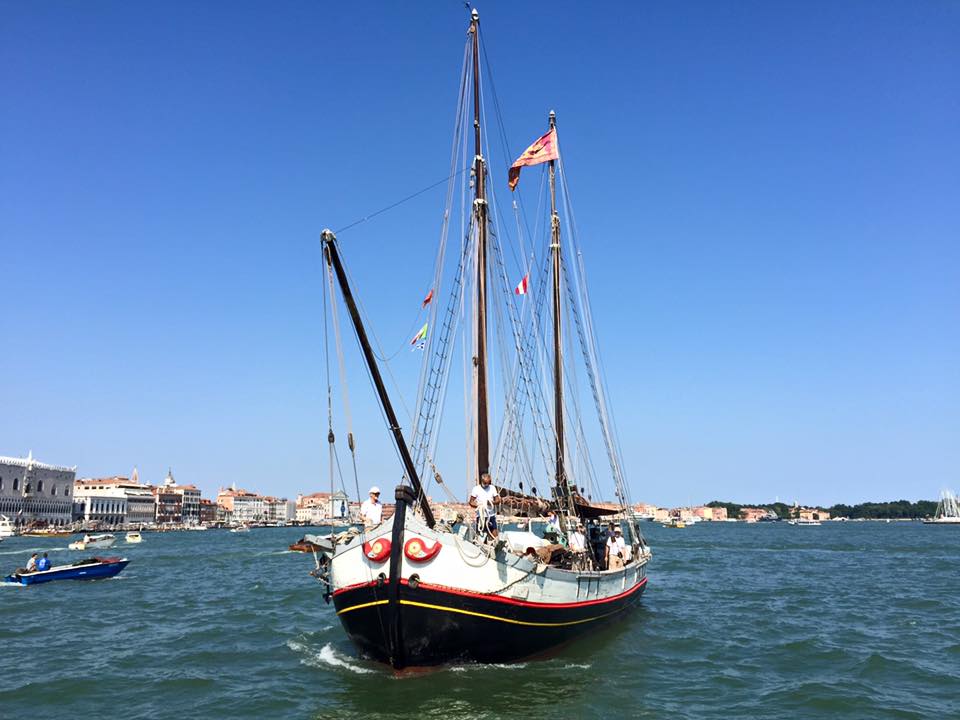
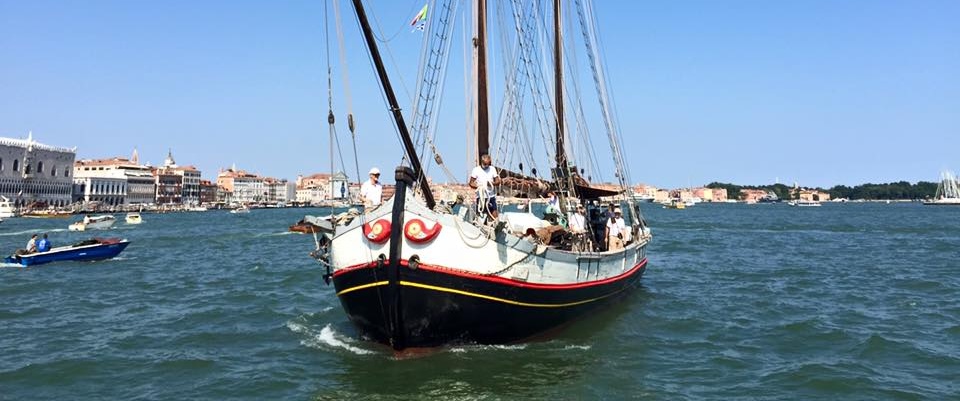
The “Il Nuovo Trionfo” lugger was launched way back in 1926 by the expert hands of one of the most important squerarioli of Cattolica: Ferdinando Ubalducci. His squero was located along the Tavollo river a few hundred meters from the sea outlet of the canal port which still today divides Cattolica from Gabicce, Emilia from the Marche. According to Edmondo Bontempi, nephew of the first commander Colombo Prioli, known as Baragoglio, the boat had been built with particular care. In fact, for the first time, Ubalducci had decided to take it under his management personally together with two other Cattolica partners, Vincenzo Morosini, known as Vincianz, and Colombo Prioli known as Baragoglio as captain. This is how Il Nuovo Trionfo became, from the second half of the 1920s, a “trafego” lugger in the summer and perhaps, as was customary, a fishing lugger in the cold winter months.
From 1939 to 1970
While little or nothing is known about the traffic of our lugger in the 1930s, we have various information on the period of the Second World War which marked the end of most of this type of Adriatic boats. Dozens of luggers were in fact requisitioned first by the Royal Navy and then by the German occupiers as troop transports, but above all as minesweepers by virtue of their wooden hull “invisible” to magnetic mines. The Nuovo Trionfo miraculously escaped bombing, sinking and requisitioning, usually with disastrous results.
The long career of Il Nuovo Trionfo continued silently until the early 1950s when it was sold to the Pinatti family of Grado who used it for dredging work from the mouth of the Po to Friuli from Punta Sdobba to Monfalcone. The Pinattis were five brothers with four luggers and the fifth was the mechanic for the other four. In their opinion, Il Nuovo Trionfo was the best built and most solid of all those they owned. With their luggers they dug and loaded gravel and sand with the bigo in various places: from the Isonzo river, to the Po di Levante, to Contarina, Donada, up to Mazzorno (the bridge did not exist at the time) but also outside Grado. The sand was loaded wet. On the bottom of the boats, a series of crossed and overlapping boards were arranged from bow to stern, designed to resist the blows of the bucket, interspersed with jute bags to allow the water to filter into the bilge. The water was then sucked in and expelled with piston pumps.
We sailed with the water on the edge of the deck and to prevent it from entering the sides of the opening, sheets of metal were placed protruding from the cargo hold.
From 1970 to 2006
Around 1970, the Nuovo Trionfo was sold to a company from Cervia for the excavation of that canal port, which however was never able to pay for it. The Pinattis decided to take it back and then sell it to Hugo Herrmann, an engineer from Vienna, of Dalmatian origins, a great nautical enthusiast, who transformed it into a pleasure boat and maintained it with care until 2007.
With the new owner, Hugo Herrmann, Il Nuovo Trionfo underwent important transformation works at the Camuffo shipyard in Grado from 1971 to 1973. The deck was remade in iroko (very hard wood), the deckhouse and interiors were built from scratch in mahogany, the keelson was reinforced with two iron plates 3 cm thick on each side, in order to avoid the typical tendency of the old boats to open their sides outwards and reverse the curvature of the keelson. The rig was completely redone, maintaining only the two masts that were installed between the 1950s and 1960s by the Pinatti family.
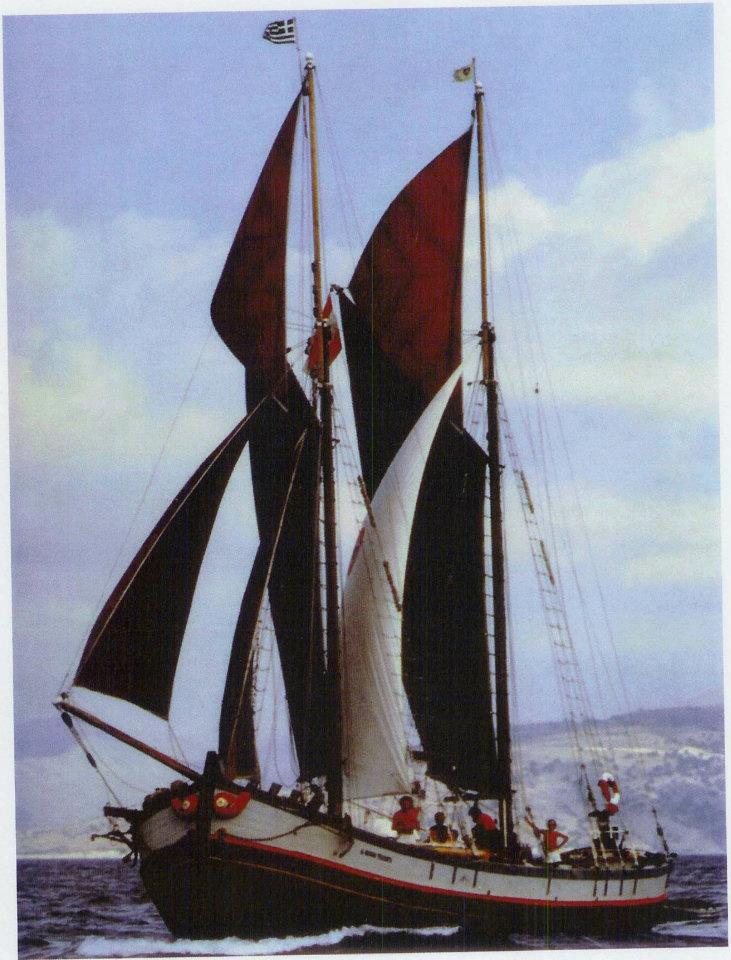
The new sails are gaff for reasons of ease of maneuvering whereas previously it was rigged with two sails on the third. Herrmann added a cast iron fin, weighing several quintals, to the keel, which was originally flat, to better ride the wind and act as ballast. Since 1984 the Nuovo Trionfo has always had Mercedes engines: it currently has a 346 model.
Since the 1980s Il Nuovo Trionfo became Hugo Herrmann’s home for at least 6 months a year and was used for pleasure and nautical training for many young Austrians. He made numerous cruises from Venice to Slovenia and Croatia, reaching as far as Greece and Turkey. The lifeboat supplied, (which now needs to be restored) traveled hanging from two hoists on the side of the boat, was built in 1985 to a design by Hugo Herrmann in Betina, on the island of Murter, so that it could carry up to 12 people.
From 2007 to today
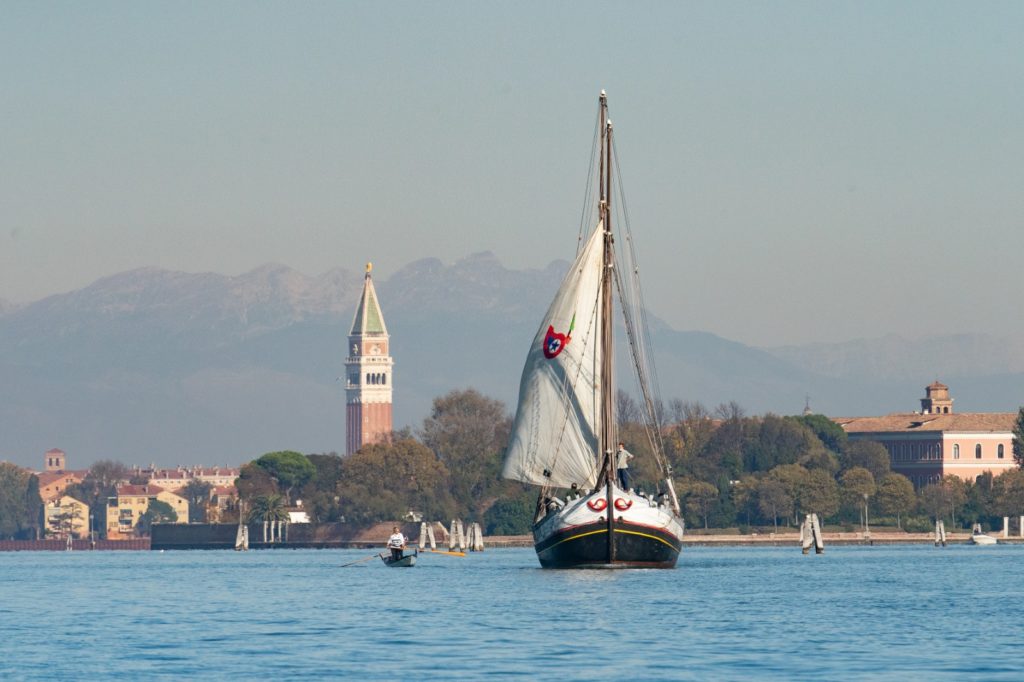
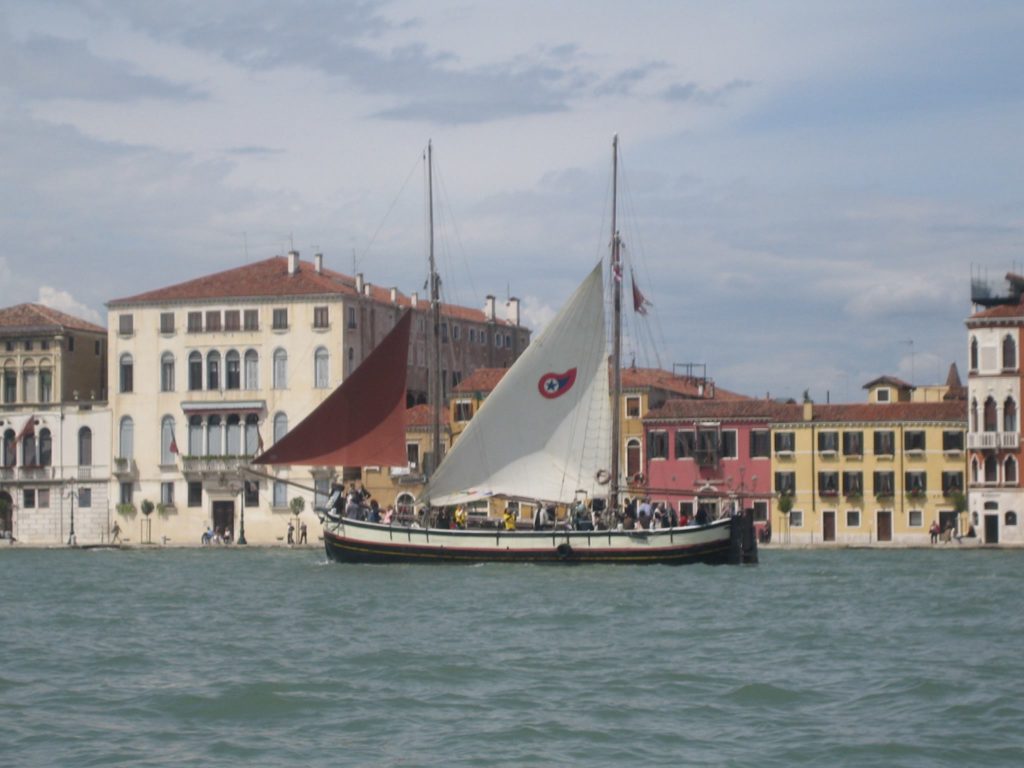
In 2007, on the idea of Alfredo Zambon and Massimo Gin, the Compagnia della marinaria traditional was formed, an association of enthusiasts born with the aim of saving the last example of this type of vessel, to restore it and use it as a training ship for disposition of Venice and all enthusiasts. On 1 April 2008 the boat was delivered as it was and arrived in Venice, finding a first mooring on the island of Lazzaretto Nuovo thanks to the availability of the Ekos Club, Archeoclub of Venice in the person of Gerolamo Fazzini. From the date of purchase until 2011, only ordinary maintenance work was carried out in order to allow the ship to continue sailing.
Between April and May 2010, some members of the Company carried out the restoration of the sailing rig of the Nuovo Trionfo which was carried out partly at the Faldis shipyard in Giudecca (generously made available by the Toffolo family) and partly at Forte Marghera. After dismasting in the yard, all the rigging was taken to Forte Marghera where there was space available to redo the shrouds, the splicing and tidy up all the ropes and halyards. In this task we were helped significantly by Hugo Herrmann who stopped in the area for about two weeks and practically replaced all the parts to be renewed (practically 90% of the ropes and halyards). Most of the shrouds, however, have been replaced with new cable called “Atlantic” including the splicing, while the required maintenance has been carried out for the remaining shrouds, still in good condition (about 20% of the total).
From the end of 2011 to March 2012, thanks to funding linked to a European project, the Cluster Club, and the contribution of the Veneto Region for traditional boats, an important restoration project was started at the Conavar shipyard in Chioggia.
During the works, the belts were completely replaced, a large part of the hoops were doubled or replaced, almost all the zappoli were redone, several hull boards were replaced, the tidy bow zoja and some mooring bollards were redone, the dovetail was redone and the nailing of all the hull, and much more.
On March 9, 2012 the restored vessel was launched.
Original Italian description below
Note Storiche
Dal 1926 al 1939
Il trabaccolo “Il Nuovo Trionfo” fu varato nel lontano 1926 dalle mani esperte di uno dei più importanti squerarioli di Cattolica: Ferdinando Ubalducci. Il suo squero si trovava lungo il fiume Tavollo a poche centinaia di metri dallo sbocco a mare del porto canale che ancora oggi divide Cattolica da Gabicce, l’Emilia dalle Marche. La barca, a quanto ci racconta Edmondo Bontempi nipote del primo comandante Colombo Prioli detto Baragoglio, era stata costruita con particolare cura. Ubalducci infatti, per la prima volta, aveva deciso di prenderlo in gestione personalmente insieme ad altri due soci di Cattolica, Vincenzo Morosini, detto Vincianz, e appunto Colombo Prioli detto Baragoglio quale capitano. È così che Il Nuovo Trionfo diventa dalla seconda metà degli anni Venti trabaccolo “da trafego” nella bella stagione e forse, com’era d’uso, trabaccolo da pesca nei freddi mesi invernali.
Dal 1939 al 1970
Mentre poco o nulla si sa sui traffici del nostro trabaccolo negli anni Trenta abbiamo invece diverse notizie sul periodo della Seconda guerra mondiale che ha segnato la fine della maggior parte di questa tipologia di barche adriatiche. Decine di trabaccoli furono infatti requisiti prima dalla Regia marina e poi dagli occupanti tedeschi come trasporto truppe, ma soprattutto come dragamine in virtù del loro scafo in legno “invisibile” alle mine magnetiche. Il Nuovo Trionfo riuscì a scampare miracolosamente ai bombardamenti, a un affondamento e ad una requisizione solitamente dagli esiti funesti.
La lunga carriera de Il Nuovo Trionfo continua silenziosamente fino ai primi anni ’50 quando viene venduto alla famiglia Pinatti di Grado che lo utilizzò per lavori di dragaggio dalle foci del Po fino al Friuli da Punta Sdobba a Monfalcone. I Pinatti, erano cinque fratelli con quattro trabaccoli e il quinto faceva il meccanico per gli altri quattro. Secondo loro Il Nuovo Trionfo era quello meglio costruito e il più solido di tutti quelli che possedevano. Con i loro trabaccoli scavavano e caricavano con il bigo ghiaia e sabbia in diversi luoghi: dal fiume Isonzo, al Po di Levante, a Contarina, Donada, fino a Mazzorno (allora il ponte non esisteva) ma anche fuori Grado. La sabbia veniva caricata bagnata. Sul fondo delle barche erano disposte da prua a poppa una serie di tavole incrociate e sovrapposte, atte a resistere ai colpi della benna, inframezzate con dei sacchi di juta per far filtrare l’acqua in sentina. L’acqua veniva poi aspirata ed espulsa con delle pompe a stantuffo.
Si navigava con l’acqua sul bordo della coperta e perché non entrasse sui lati dell’apertura erano messe delle lamiere sporgenti dal cassone della stiva.
Dal 1970 al 2006
Nel 1970 circa il Nuovo Trionfo fu venduto a una ditta di Cervia per lo scavo di quel porto canale che però non riuscì mai a pagarlo. I Pinatti si decisero a riprenderlo indietro per poi rivenderlo a Hugo Herrmann, un ingegnere di Vienna, di origini dalmate, grande appassionato di nautica, che lo trasformò in barca da diporto e lo mantenne con cura fino al 2007.
Con il nuovo armatore, Hugo Herrmann, Il Nuovo Trionfo subì dal ’71 al ’73 importanti lavori di trasformazione presso i cantieri Camuffo di Grado. Fu rifatta la coperta in iroko (legno molto duro), costruita ex-novo la tuga e gli interni in mogano, fu rinforzato il paramezzale con due piastre in ferro di 3 cm di spessore per parte, al fine di evitare la tendenza tipica delle vecchie barche ad aprire le fiancate verso l’esterno e a rovesciare la curvatura del paramezzale. L’armo fu rifatto completamente mantenendo solo i due alberi che furono installati tra gli anni ’50 e ’60 dalla famiglia Pinatti.
Le nuove vele sono auriche per ragioni di comodità di manovra mentre prima era armato con due vele al terzo. Alla chiglia, originariamente piatta, venne aggiunta da Herrmann una pinna di ghisa, di diversi quintali per meglio risalire il vento e fare da zavorra. Fin dal 1984 Il Nuovo Trionfo ha avuto sempre motori Mercedes: attualmente monta un modello 346.
Dagli anni ’80 Il Nuovo Trionfo divenne la casa di Hugo Herrmann per almeno 6 mesi all’anno e venne utilizzato per diporto e per formazione nautica di molti giovani austriaci. Fece numerose crociere da Venezia alla Slovenia e Croazia, spingendosi fino in Grecia e Turchia. La scialuppa in dotazione, (che ora deve essere restaurata) viaggiava appesa a due paranchi sulla fiancata dell’imbarcazione, fu costruita nel 1985 su progetto di Hugo Herrmann a Betina, sull’isola di Murter, perché potesse portare fino a 12 persone.
Dal 2007 ad oggi
Nel 2007 su idea di Alfredo Zambon e di Massimo Gin, si formò la Compagnia della marineria tradizionale, un’associazione di appassionati nata con la finalità di salvare l’ultimo esemplare dei questo tipo d’imbarcazione, per restaurarla e utilizzarla come nave scuola a diposizione di Venezia e di tutti gli appassionati. Il 1° aprile 2008 la barca venne consegnata così com’era e arrivò a Venezia, trovò un primo ormeggio presso l’isola del Lazzaretto Nuovo grazie alla disponibilità dell’Ekos Club, Archeoclub di Venezia nella persona di Gerolamo Fazzini. Dalla data di acquisto fino al 2011 sono stati esclusivamente eseguiti lavori di manutenzione ordinaria al fine di permettere che la nave continuasse a navigare.
Tra aprile e maggio 2010, alcuni soci della Compagnia hanno realizzato il restauro dell’armo velico del Nuovo Trionfo che è stato effettuato in parte presso il Cantiere Faldis alla Giudecca (messo generosamente a disposizione dalla famiglia Toffolo) e in parte a Forte Marghera. Dopo aver disalberato in cantiere, tutte le manovre sono state portate a Forte Marghera dove c’erano spazi disponibili per rifare le sartie, le impiombature e riordinare tutte le cime e drizze. In questo compito siamo stati aiutati in modo determinante da Hugo Herrmann che si è fermato in zona per circa due settimane ed ha praticamente sostituito tutte le parti da rinnovare (praticamente il 90% delle cime e drizze). La maggior parte delle sartie invece sono state sostituite con nuovo cavo detto “atlantico” comprese le impiombature mentre per le restanti sartie, ancora in buono stato (circa il 20% del totale) è stata fatta la manutenzione prevista.
Dalla fine del 2011 al marzo 2012, grazie ad un finanziamento legato ad un progetto europeo, il Cluster Club, e al contributo della Regione Veneto per le imbarcazioni tradizionali, si è potuto avviare un importante intervento di restauro presso il cantiere Conavar di Chioggia.
Durante i lavori sono state sostituite completamente le cinte, raddoppiate o sostituite gran parte delle rifatti quasi tutti gli zappoli, sostituite diverse tavole dello scafo, rifatta la zoja di prua ordinate e alcune bitte di ormeggio, rifatta la colomba rifatta l’inchiodatura di tutto lo scafo, e molto altro.
Il giorno 9 marzo 2012 l’imbarcazione restaurata è stata varata.
Photos
Map
No Records Found
Sorry, no records were found. Please adjust your search criteria and try again.
Google Map Not Loaded
Sorry, unable to load Google Maps API.
Comments
Owner’s Description
Photos
Map
Comments