The Recording of the Live Presentation is Now Available Below
Here are the links from Evelyn’s slides:
-
- Herreshoff Marine Museum Updates
- Herreshoff Catalogue Raisonné
- MIT Museum
- Library of Congress Historic Photo Collections
- Historic New England Nathaniel Stebbins Collection
- Boston Public Library Leslie Jones Photo Collection
- Mystic Seaport Museum’s Yachting Registers
- The Bristol Phoenix (especially for HMCo. stories)
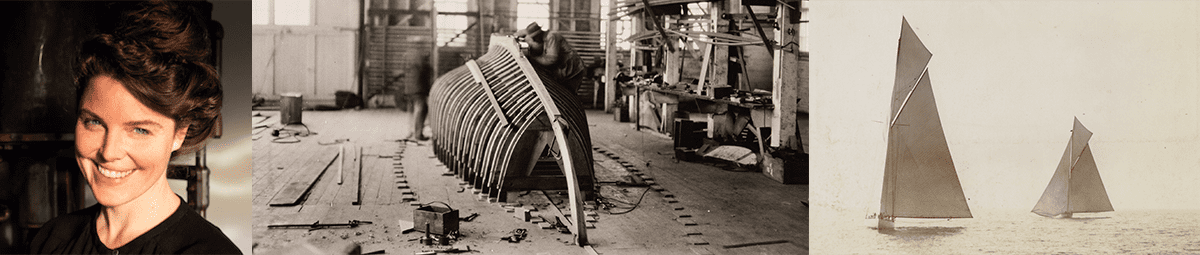
The Pandemic may have stopped our in-person activities short, but it also gave us an unexpected opportunity to dig into the archives while on lockdown. Thanks in large part to extraordinary recent developments in the digitization and transcription of previously unpublished material from collections around the world, we have been putting together pieces of the historic puzzle in a manner that was not possible even five years ago. Join us as we explore recent discoveries from this new age of historic exploration: boats long forgotten or never built, photos that haven’t seen the light of day for a hundred years, previously unidentified models, and long forgotten Gilded Age tales of ocean-spanning cruises… whatever you’ve heard before, this is not the same-old, same-old Herreshoff!
Speakers:
-
-
- Evelyn Ansel – Curator, Herreshoff Marine Museum
- Moderator: Maynard Bray – Co-founder, Off Center Harbor & the Worldwide Classic Boat Show
- Moderator: Nate Rooks – Off Center Harbor & the Worldwide Classic Boat Show
-
Thanks Evelyn, all I can say is Wow! What a wonderful thing you are doing for humanity and the boating world. I’ve enjoyed the show immensely and I’ll definitely stop in to see more when I’m visiting Mystic.
And thanks also to Maynard, Nate and OCH for putting this all together. Being slightly landlocked in Indiana, this sure brightens my day!
Evelyn thanks for the insightful stories and illustrations of the expanding capabilities of the various data bases related to Herreshoff. Regarding Mystery Model 1- Extreme beam half model #1209 of 1875. She may be the final step of a single hull design, before NGH jumped to the “double boat” catamaran. I refer to NGH’s letter published in the New York Herald April 16, 1877 where he described his effort to get great speed out of a single hull with larger sailing rigs by increasing sectional surface, (hull beam) until it came to him to make the split to the double hull catamarans of 1875- 1879. John Palmieri
What wonderful insight. Your enthusiasm is contagious, Evelyn. Thanks so much.
Thank you for a wonderful presentation. Always enjoyable learning about the histories of the sailing communities and builders! Bravo!
Fantastic presentation thank you. I’m still smiling.
We have the technology to bring the interiors alive with 3D cad and rendering. Will hope and look forward to more stories.
Thoroughly enjoyed the HMM presentation and kudos to you, Evelyn, for your persistence and stamina in digitizing the treasure of these archives. My respect for the Hereshoff legacy as brilliant naval architects and builders is only exceeded by my respect for their wisdom in so carefully documenting their production at the time their production was so fervently taking place. I hope to visit the HMM this coming summer from my current homeport in Portland, Oregon. I am certain the destination will be the highlight of my planned summer travels. Thanks for the peek into this magnificent resource. OCH scores another great video.
Thanks for this. Such a terrific job of making a museum collection come alive, and what a collection! The effort to digitize and make searchable information residing in different places and archives is surely a model for many in the museum and library worlds.
As for the dearth of photographs of interiors (photography being my thing), even into the early 20th century films were relatively insensitive, and lens apertures relatively small, meaning long exposures were required in dark places like below decks. Taking a good picture of quarters would require professional skills, using a tripod … or possibly with flash powder, although Evelyn’s story about the explosion suggests that boat owners might have taken a dim view of that idea. Little wonder most pros preferred to spend all their time outside in the sunshine.
Thanks Andy, you make great points!
Wonderful and expert presentation. Interesting and a delight to experience.
Well done. Thanks, Evelyn!
Amazing! Thank you for a great talk!!
thanks!
Would you (Evelyn) say that your studies at Brown prepared you well for what you’re doing?
might say that OCH has videos of HCR & MIT
Brilliant presentation; great presenter (moved along quickly, totally engaging). Thanks v much.
what are the best known designs from Haffenreffer period of ownership?
Hi Van, probably the Fishers Island 31s, the Fishers Island 23s, the Potter B-class frostbite dinghies & Tech dinghies are among the best-known today. They were also still building 15s and 12 1/2s throughout this period, designed a few Q and R boats, and experimented with things like the Amphicraft and development class designs. They were still building power cruisers during this period, and this was also when HMCo. started building boats to outside designers’ plans more regularly. This included designs like the Northeast Harbor 40 sq. m class, the frostbite and Tech dinghies, and candidates for the 1934 and 1937 America’s Cup competitions like ENTERPRISE, RAINBOW and WEETAMOE. It is worth noting also that while Captain Nat had stepped back in this period and A. Sidney was leading the design department, Captain Nat’s last official design for the company was that of BELISARIUS, built in the winter of 1934-1935, so there was still some overlap there too.
Notice half hulls behind you are facing both left and right. Modern inclination is for American models bow to the right and British to the left but NGH seems to be either way. Random choice by him. Great program, thanks
That’s correct! Captain Nat was ambidextrous with his model directions, and as best we can guess it probably depended on the qualities of the stock he had on hand for carving. Whichever way he chose, the construction drawings almost always match the direction of the model.
Is there a “family” reason that L. Francis appears to be under represented in the museum?
Hi Jonathan, HMM has some material pertaining to L. Francis, but the majority of his design archive resides at the Mystic Seaport Museum. We are certainly great appreciators of L. Francis and believe he deserves to be celebrated as widely as HMCo. and the previous generation! But we tend to defer to Mystic when it comes to collecting, since they already have such a substantial body of his work in their collection. I do think someday when/if we have an exhibit space suitable for loans and big traveling exhibitions, we’d absolutely love to do an L. Francis exhibit – but that would be some years away at this point.
Thanks Evelyn. Years ago I donated an original newspaper article that had an amazing quote of Sir Thomas Lipton concerning his losses to Herreshoff boats in the America’s Cup races that I think you’d enjoy if you can find it.
Lipton said “They tell me I have a beautiful boat. I don’t want a beautiful boat. What I want is a boat to lift the Cup, a Reliance. Give me a homely boat, the homeliest boat that was ever designed, if she is as fast as Reliance.”
… and were the electric boats steered by lines and yoke methods?
Hi Evelyn, Great presentation. Wow. So well written and delivered. Any idea if other electric motor suppliers than Holtzer were considered or tested? Thx. Margaret says hi.
Dear Dave and Margaret:
I am restoring an old Hinckley that lost its engine many years ago. In considering my options, I came across the all-electric system developed and marketed by the Elco Motor Company, which has been making marine engines for 130 years. Here is a link to their website: https://www.elcomotoryachts.com/our-story/.
Good luck with your project! -Gary
Thanks Gary, but we aren’t contemplating an electric motor project currently. Evelyn’s response during the Q&A that the Holtzer motors were in wide use at the HM Co plant was interesting! It never crossed my mind that would have been but it stands to reason. And they used electric power hand tools also!
Question for Evelyn Ansel:
I am in the process of restoring a 1949 Hinckley 34′ Sou’wester that is missing its original engine. In fact, it has no engine at all. I am thinking about installing an electric propulsion system and would like your advice on (1) whether that is a good idea or not, and (2) have you had any experience with the Elco electric systems for sailboats?
Thank you!
Gary Cunningham
Leo Goolden of Sampson Boat Works has a great video about his reasoning for choosing a diesel/electric hybrid engine for the rebuild of the Albert Strange designed yacht Tally Ho. https://youtu.be/xohxmwPfctg
Thanks Howard. That is a fantastic series of videos about rebuilding a century old 120′ sailboat. Lots of good food for thought!
My restoration project for Loon is much less ambitious than the one undertaken for Tally Ho. And unlike Tally Ho sailing nothing but wide expanses of the ocean blue, Loon will probably spend most of her time harbor hoping in the Great Lakes. So one of the challenges will be to find a small enough hybrid system to consider. But it is definitely something I am going to keep in the back of my mind as I move forward with breathing new life into an old Hinckley.
Please stay in touch and I will do the same. -Gary