
The Recording of the Live Presentation is Now Available Below
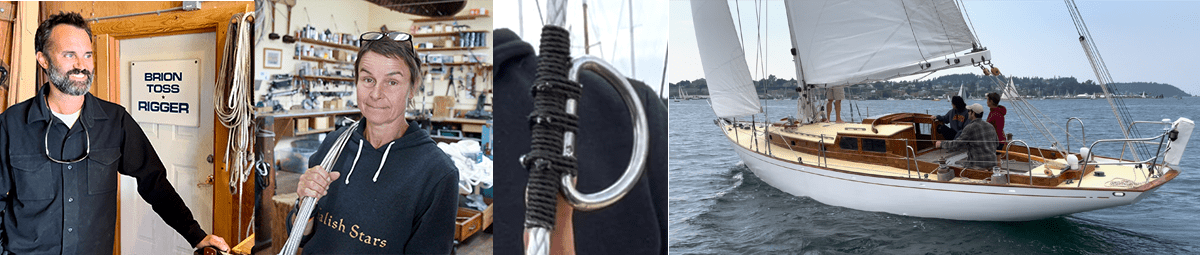
These master riggers will explain the advantages of synthetic fiber over steel rigging systems and talk about its numerous benefits for modern and classic boats. They will explain how Brion Toss Rigging, being skilled in the traditional, is so well versed to adapt the traditional skills to the modern fiber.
“Wire rigging is, after all, the attempt of a previous generation to do with wire what they had previously done with rope. A couple of hundred years later, we are just running things the other way.” – Brion Toss.
Visit Brion Toss Yacht Riggers in Port Townsend, WA.
Speakers:
- Ian Weedman – Co-owner, Rigger, Brion Toss Yacht Riggers
- Jen Bates – Rigger and Fiber Guru, Brion Ross Yacht Riggers
- Moderator: Eric Blake – VP, Brooklin Boat Yard and Co-Founder, OCH and the Worldwide Classic Boat Show
On behalf of mere mortals without deep pockets. Once again, the same question as several times below. What is the cost comparison between SS and synthetic including labor to replace rigging..say on a 30 ft boat ?
The cost is about the same. Tangs will need replacement as synthetic thimbles are physically bigger.
Hi George,
I can not comment about cost for a 30 footer, simply because configurations vary so much amongst designs. Fiber rigs are a bit more expensive than stainless steel, because the per foot cost of the material is more than SS. In my (slightly biased) opinion, the cost/benefit makes it worthwhile. Other factors come in to play as well. What details will need to be changed so the rig can accept fiber? In replacing SS for SS, similar considerations need to be made. For example, do the tangs and chainplates need to be renewed?
Happy to chat further if you wish.
Ian
rigging@briontoss.com
Excellent topic and presentation! Like others, I’m curious about cost comparison to stainless and calculating the length. Will the OCH video on Varya include tuning? Again, huge thanks to Ian and Jen for sharing their knowledge.
Hi Kaci,
Good point on calculating lengths. We didn’t have much time to get too deep into this topic, but it is the one worth talking about. We may be a little secretive about how we get such accurate lengths with fiber, but it is still worth talking about to dispel some of the negative myths about this material. Getting this detail wrong has led to the misunderstandings of creep and stretch, which has led to some people believing it is not a good material for standing rigging.
Tuning is another good one. We are hoping to work more with the lovely OCH crew to further explore the nuances of fiber standing rigging on sailboats.
Port Townsend, PNW is a far cry in UV exposure to the tropics. What is the life of dyneema in the south/tropics?
Hi Suzan,
You are right, we are not blessed with excessive exposure to the sun out here. While we do pay close attention to our local fiber rigged boats. Most of the data we are drawing from has been from rigs that have crossed oceans and holed up in the northern climates as well as the tropics. You will get an identical, working life to stainless steel rigging. In the temperate climates, this is 10-12years. In the tropics, 7-8. Many people far exceed these timeframes, and in both materials, all bets are off as safety factors diminish.
Cheers,
Ian
Also, did I miss any mention of cost vs stainless steel? It seems that there is a lot more hand work involved in using dyneema.
This is a very compelling presentation.
Last year my son and I re-rigged my Bristol Channel Cutter 28 with Dyneema. The weight savings aloft had a stunning effect on the pitching moment of such a short ended boat. It also improved the sail carrying ability allowing us to power upwind. All in all a fantastic performance improvement. Many thanks to the folks at Colligo Marine for guiding us through the process.
Very informative show. Thank you! Question: What is the comparative recyclability between stainless rigging and dyneema?
Thanks,
Pete Huber
“Lifwynn”
Charlotte Sailing Center
Charlotte, Vermont
What about cold weather and ice? any issues?
Extreme cold weather will show a minimal elongation of the rigging.
We have not observed this to be any sort of a problem. As for ice, no issue.
Cheers,
Ian
Excellent presentation. This question is for Jen. How. Has your time training with Brion and his mentor ship influenced your ability now to excel at the fabrication of synthetic rigging. Crap. Same question as Ericks!
Great talk. Say some more about matching traditional looks. Serving, what else? Colors?
So much to say here. In a nutshell, serving a fiber rig, will make it indistinguishable from serving an iron rig.
Cheers,
Ian
1) If you are achieving strengths of 3 to 5 times a steel rig with Dynema why are you not reducing the size of the synthetic rope.
2) how do costs compare with stainless steel?
Hi Ian,
Excellent question. We have to approach dyneema fiber rigging with a different language and understanding from what we are used to with steel rigging systems. Strength is not our defining factor, stretch is, and that is what we design for.
Best,
Ian
I rigged a 21ft gaff cutter I restored with dynema, and after 3 seasons I love it. My challenge was setting up the rig initially. I spliced soft eye uppers and pre-stretched, but couldn’t accurately get finished lengths until the mast was stepped, so I spliced the lowers after the mast was stepped, and set the length to the maximum span of the turnbuckles. Significant stretch during the first season used most of the travel in the turnbuckle. So, do you have any tip for dealing with stretch for splices put in after the rig is up?
Thanks
Bill Theurkauf
Hi Bill,
What brand and variety of Dyneema did you purchase for your rig? While there are many Dyneema’s available off the shelf at common chandleries, there are very few varieties suitable for standing rigging. This has to do with the material properties of stretch and creep. If you experienced a significant stretch within the first season, either the wrong variety was used, or the fabrication procedure was incorrect. Happy to chat with you about this if you wish.
Cheers,
Ian
rigging@briontoss.com
Ian, I used Dyneema Endura 12 on Sojourn, 1/4″ for the main(222sf) 3/16″ for the mizzen(25sf). The rigger at local chandlery was helpful showing how to bury the tail in Brummel but didn’t have any advice on stretching. I’ve reached the end of turnbuckle travel after one season and need to redo the Brummels. Thanks, Steve
I’d like to know how to account for construction creep also. I’ve reached the end of the turnbuckle travel on Sojourn (20′ gaff yawl) and need to redo the lower splices. I’ve done it once before and it would be nice to know if there is a way to calculate the creep.
Cost Comparison?
cost modern fibre vs stainless?
Maybe I missed it but can you compare the cost of Fiber Rig
to comparable Stainless Steel?
What is the cost comparison? And what about rod rigging? Really interesting and informative. I’m sold on the inspection ability alone. Except for the fact I have unstayed carbon fiber masts…
Please explain more fully why dyneema needs to be one diameter larger than 1/19 stainless.
Hi Thomas,
We size Dyneema larger to match the stretch characteristic of the steel system that it is replacing.
Cheers,
Ian
Is there published books on the rigging of Dyneema rigging?
Not yet, but stay tuned. In the meantime, Colligo Marine provides a lot of valuable information.
Best,
Ian
Please comment on issues regarding lightning. Is there less of a electrical cage using fibre shrouds?
Hi Ken,
Nuanced topic. I got your phone message, let’s chat further soon.
Best,
Ian
question: how does synthetic rigging mitigate chainplate failure as you mentioned in the beginning of your presentation? also is service the main way to prevent chafe?
Thx
Hi Dennis,
Synthetic fiber rigging does not mitigate chainplate failure. The example of those stainless chainplates was only to expose the failure modes of stainless steel. Those same modes of failure, operate with stainless rigging wire. Heat set Dyneema does not have the same failure modes.
Cheers,
Ian
Is there a rigging shop or boat yard on the East Coast who is experienced with dyneema rigging?
question. If it is not covered during the presentation, with a headstay supporting roller furling, would that remain as wire, or will fiber work there as well