
Electric Propulsion & Solar Cruising – The Future is Now
Wednesday Feb 23, 2022 at 7:00pm EST in the U.S. (4:00pm PST)
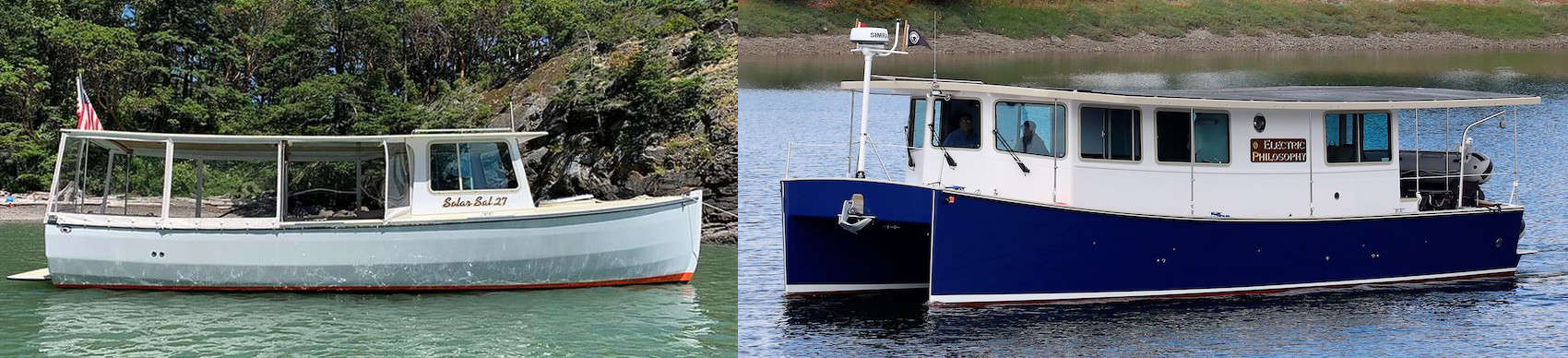
This panel of designers, builders and owners will discuss the concepts of “electric boating” versus “solar boating”, and then we’ll leap into the fast-approaching next phase of electric propulsion — solar cruising (cruising with unlimited range relying only on solar charging and electric power). We’ll look closely at two boats that cruise with unlimited range powered only by the sun and never plugging in (the future is now).
Speakers:
- Moderator: Steve Stone, Co-Founder of Off Center Harbor and the Worldwide Classic Boat Show
- Joe Grez – Electric Motor Designer – Electric Paddle / EP Carry
- Sam Devlin – Wooden Boat Designer & Builder – Devlin Boats
- Alex Borton – Co-Owner – Solar Sal Boats
If you’ve enjoyed the show, you can support our work in these two ways:
-
You can CLICK HERE to become a member of Off Center Harbor.
-
You can CLICK HERE to make a donation for this year’s boat show.
Thank you!!!
Have something to say or ask? Post your comments or questions in the chat below.
will a recording of this presentation be made available?
After the show, the presentation recording will be available on http://www.offcenterharbor.com
Wonderful insights to a developing industry. My two big take away’s were Low speed is good for range, and you don’t really need to plug in to charge – FREE lifestyle is great. I played a bit with a small electric trolling motor (1/4 hp?) on a 16′ Widgeon sailboat. Main problem was in rough seas, but fine in calm waters. Thank to all including the design insights.
What was the build cost of the solar catamaran? Sounds like a great long-term solution to cruising.
Great discussion. Thank you all, and thanks for posting the video after.
I would like to see more discussions on solar electric cruising and solar electric auxiliaries for sailboats.
Sorry I missed your show! I converted a Voyage 440 sailing catamaran to an all electric/solar powerboat in 2016, we spend about 6 months a year living on it. 20 solar panels for 7200 watts, two 15 KW Oceanvolt electric motors, two 17 KW diesel generators (for backup and overnight cruising) and Super B LiFePO4 batteries. Typical cruising is 15-20 miles a day island hopping, cruising at 4.5-5.0 knots. Spent 7 weeks in the Abacos last year without the generators ever starting. Details at Indigo lady Conversion to Solar on Facebook or email me at daveonindigolady@gmail.com
We are looking to power the 1938 18ft Poulsbo boat “Lyra” It was rebuilt in 2017 at the school in Hadlock. Had a Yamaha 8hp on it. Any suggestions?
Excellent discussion. Thank you all.
thank you
Thanks
What an amazing trip to Alaska! Thanks for the talks, all!
in design terms, do sailing rigs and solar panels work together?
Hi Felix, Your rig will always cast some shadow in your panels, so you will need to be thoughtful in your panel wiring. Choose high voltage panels (70 VDC) and wire them in parallel. That way if any panel is shaded, it will not contribute but the others will.
Would converting a 22′ Marshall Cat by removing mast /keel, adding a cabin top be a good candidate to go electric?
Adding a roof over a cat provides welcome shade in the cockpit as well as a great platform for lots of panels.
Would a power cat in need of a repower be a good candidate for solar cruiser conversion?
Power cats typically run at speeds that would eat a lot of battery capacity. Pushing a cat at speeds above 5 knots will nearly double the power required for each knot! If you can accept 5 knot cruising, then yes it would work. If you need the 10 knot speeds, then stay with the diesels or invest in huge battery banks (like the new electric pickup trucks do).
Now I see them – sorry
I’m not seeing or hearing the questions – I can hear the answers. Am I doing something wrong?
Preference for AGM or Lithium Iron Phosphate? Thanks.
To what extent is electric and solar sailing likely to benefit from present rapid developments in electric road vehicles?
Please evaluate the risks (or not) of a variety of high tech batteries on electric boats.
Cost about $6000 in fuel for me to go to Alaska in a 30 ft Cabin Cruiser. Speed around 15Knots
How does the EP Carry outboard motor housing relate to water?
I recently discovered salt water batteries. Does anyone know if these would work for solar cruising?
perfect trolling speed, did you catch any fish?
Great presentations and information – thank you to the presenters! The non-profit I lead, Susquehanna National Heritage Area in Pennsylvania, recently acquired the Chief Uncas, a 1912 ELCO 55ft electric motor yacht, for service as our public tour boat on the Susquehanna River starting next summer. The Chief Uncas is in the boat show at this link: https://dev.classicboatshow.com/listing/chief-uncas-27-elco-power-cruiser-1930/. To learn more about our organization and our boat tours visit us at our website here: http://www.susqnha.org. We’re also on Facebook @SusqNHA, where you can follow us for future updates on the Chief Uncas tours.
fabulous, thanks Joe.!
Would appreciate any observations regarding electric outboards and the newer Temo unit, mostly for dinghies.
Would love to have a complete comparison in long term costs. Like a 100 percent solar powered boat around 30ft running at 10knts X a diesel powered similar boat with similar speed. We hear that, while buying an electric car, most people ignore the hidden huge costs of replacing batteries in ? years… Same case here? Thanks a lot from Brazil.
In 2018 I completed a build of a solar electric boat. It is based upon the P.W. Blandford design called Nomad and is stretched from 16 to 18 feet. The propulsion system is a 2 kW Torqeedo outboard motor, 900 Watts of solar power and 3600 Wh of lithium iron phosphate battery storage. On a sunny day in Toronto I can travel 40 Nm at 4.25 knots and or travel 20 Nm in the dark. Under full sun I can travel at 3 knots and charge the batteries. September prior to Covid I cruised the Rideau Canal from just north of Kingston to Ottawa and back. I plugged in three times in fourteen days and did so mainly because power happened to be available. A description of my build was published by “Small Craft Advisor” magazine issue 120. Quiet cruising is wonderful!
We have been enjoying electric cruising on our 1930 Elco Marinette with an EP-20 Elco motor & 6 Lithium (LiFeP0) batteries since 2017 and will never go back to loud, stinky propulsion again. The shallow draft and quiet motor enable us to cruise the many creeks and rivers near us and sneak up on wildlife and unsuspecting neighbors. I certainly agree that this is the future of boating, but I also love that we are also honoring the past with this 92-year-old electric beauty.
I would appreciate some advice.
In 2017 we launched a 65′ gaff steel cutter, the Edgar J. March. You’ll find her on the show.
The intention was to have a diesel-electric propulsion, with a Steyr 144E38-based 60 KW generator charging a 45 kw Lithium Ion battery pack, feeding two 60 kw electric motors, designed by a British company, MSP.
Thus, she could run silently for an hour (in spite her 70 tons, it takes little power to run Edgar J. March at 5 knots) before the generator would kick in.
In 2017, the vessel was ready , awaiting the engine. Following months of delays, MSP suddenly announced they were unable to provide the engine system.
The cutter was parked at great cost on land in Poland, we live in Stockholm, and winter was approaching.
So, as a temporary measure in order to limp home, we got them to send us the Steyr. We exchanged the generator part fitted on the Steyr with a hydraulic system feeding the two engine shafts. We’re still sailing with this temporary system, which is unsatisfactory.
Now, the question:
If I were to return to the hybrid electric propulsion, what would be the best (ie economical) solution?
Or should I wait some years for lower prices?
I have the generator that came fitted on the Steyr.
Thanking you in advance,
Christopher H. Lund
Gee whiz guys, I designed and built my private, all plywood build, Totally Electric Powered Solar boat from 1986 with a lengthening from 30 to 40 feet in 2007.
Of course I am only on the east coast in North Carolina and news might be too slow what with our southern drawl. Been contacting you to get into the World Wide thing you’ve got going on but so far no number in a circle in old NC but have seen a few other boats indicated nearby. mogcanalboat.com has a picture and some data. George McNeir
Hi George. Looks like your ALGEMAC II, a 40′ Solar-Electric Cruiser is in the show, so she should be showing up on the map in NC, despite the southern drawl. Here’s the link:
https://dev.classicboatshow.com/listing/algemac-ii/
And lots of classic boat enthusiasts nearby you around Wilmington on the Guest Map:
https://dev.classicboatshow.com/guest-map/
Folks. I have a friend with a 24 foot barge type houseboat design with a junk rig sail, plus 2 Torqeedos, The sailor is physically limited, but not limited to local waters. She has cruised up and down the Maine coast in comfort and safety. The boat is slow, of course, but draws little, so she can find anchorage even if she bottoms out with the tide. Even on 2 weeks trips, she never had to connect to any power! Wind and solar took her everywhere. On long passages, she averaged close to 4 knots. The world needs more of these boats, and slow down to enjoy the experience. A lot of us might find going slower and quieter is actually more fun. Thanks for producing some good alternatives for cruising or just getting out on the water.
hey, Chubba, thanks for the mention! Just to add a little clarification, those 4 knot averages are with a really good breeze 🙂 But on the other hand, sometimes I was gone for a good bit more than two weeks, and although the boat is fitted with shore power chargers, the only time I used them was after the boat was pulled out of the water the beginning of November and inside a shed for some work, so couldn’t get sunlight. Though I REALLY noticed the decrease in capacity by about the middle of October, here in downeast Maine.
This presentation is WONDERFUL! I learned so much, and it really helps with understanding particular design issues that I approached by guesstimate and use of available space. The results are right in line with what would be predicted by what everybody said in this program – the solar panel area on this boat is adequate for judicious motor use, in combination with periods of sail-only for long trips. But previously I was a motorless sailor, so the pace suits my inclinations, and feels quite luxurious compared to how long it sometimes took to get places motorless. The boat is Great Auk, and can be seen here: http://www.sailingauklet.com
Some videos of the MOG solar boat with older electric motors and new Torqeedos….
https://www.youtube.com/watch?v=Qc2E9ebuYXI
https://youtu.be/TLpwebmnKhs
https://www.youtube.com/watch?v=LCZvUGx326I
Wow.
It is great that your group has allowed the MOG Canal Boat to appear on the World Wide Classic Boat Show map. My thanks are not only for the MOG Totally Electric Powered Solar boat but are for, with hope, many folks who might be interested in funding a build of there own with a proficient boat builder or building their own.
I am not in the business of building solar boats for others. However, I am most interested in allowing my hard won knowledge to encourage others all over the world to question the current paradigm of petroleum and wind. No slight is intended to power or sail boats, instead the warranted inclusion of totally solar electric boats.
My blog and site, although small and not slick, is for the beginner and professional to query the data, form opinions and challenge current technologies as well as themselves.
Do persist in your wonderful efforts to expand the very best in boat building and allowing me to make some small contribution.